
Saint Catherine, c. 1150
TIBERIUS – DIRECTSALE
Selling price
€ 153.600
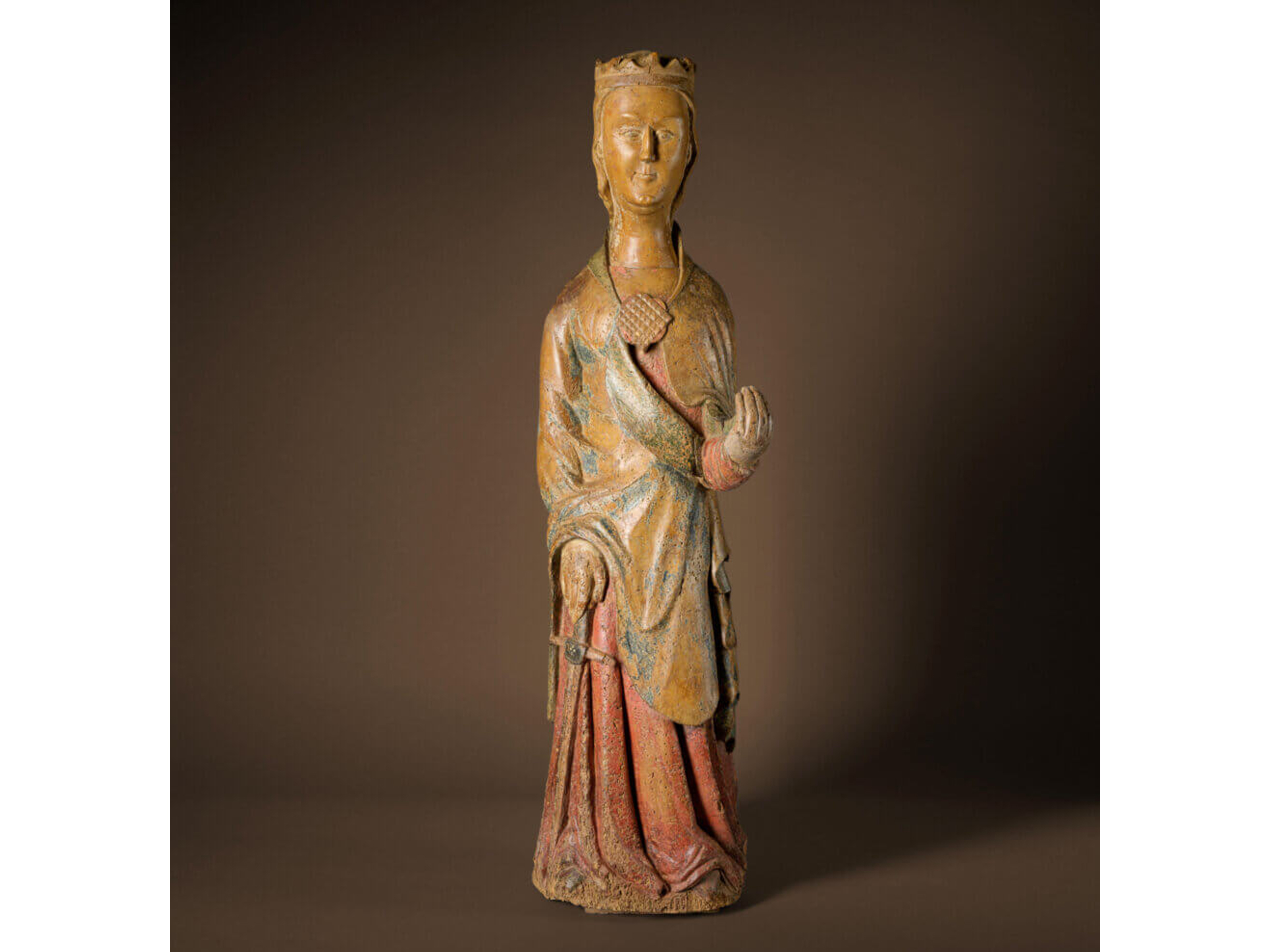
Saint Catherine, c. 1150
Romanesque rarity
Alpine style
c. 1150/70
Carved from walnut wood
Traces of original polychromy
Height 99 cm
On display:
Gothic & Mining Museum, Leogang
January 2024 – January 2025
According to tradition, Catherine was a princess from Cyprus. She rejected all suitors, recognized Jesus Christ as her true bridegroom, and traveled to Alexandria. There, she refused to offer a sacrifice to idols before the Roman Emperor Maxentius, who subsequently had her tortured. Among other things, she was broken on the wheel and ultimately beheaded.
The martyr is considered one of the Fourteen Holy Helpers and is regarded as the most important of the holy virgins. The following folk saying is well known: “Margaret with the worm, Barbara with the tower, Catherine with the wheel—these are the three holy maidens.”
Numerous aspects attest to the rarity and museum-quality of this highly significant figure. While sculptural depictions of Saint Catherine are common in the Gothic period, this Romanesque-era sculpture—dated as early as the mid-12th century and in this exceptionally good state of preservation—is likely unique. The oldest fresco depicting Saint Catherine was created in the first half of the 8th century, and the legends surrounding her life were eventually established in the following century. In the 10th century, she was included in the list of saints, and in the 12th century she was regarded as the patron saint of the Crusaders; in the 13th century, additional patronages were added, including those of virgins, wives, philosophers, teachers, printers, hospitals, and libraries.
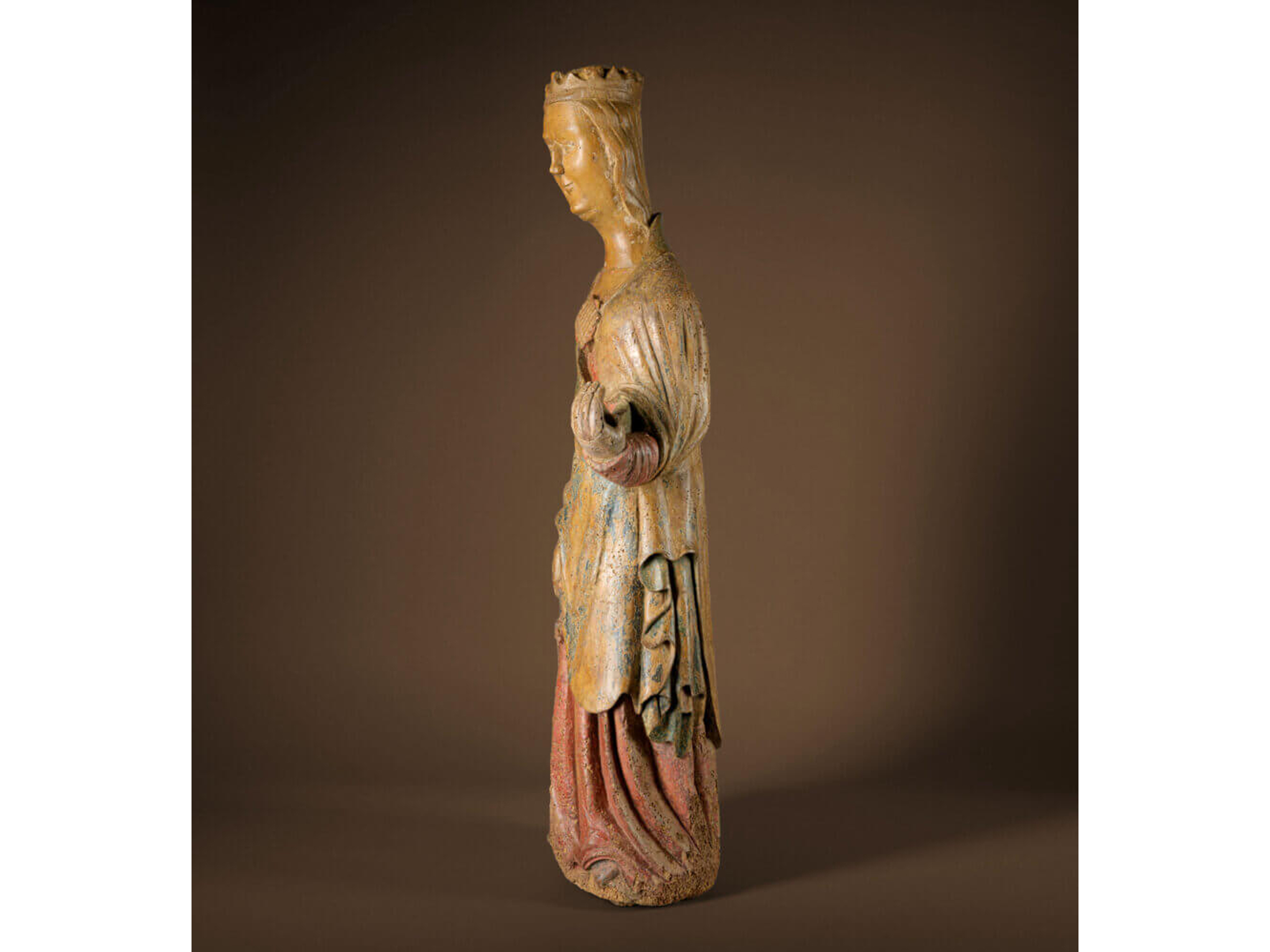
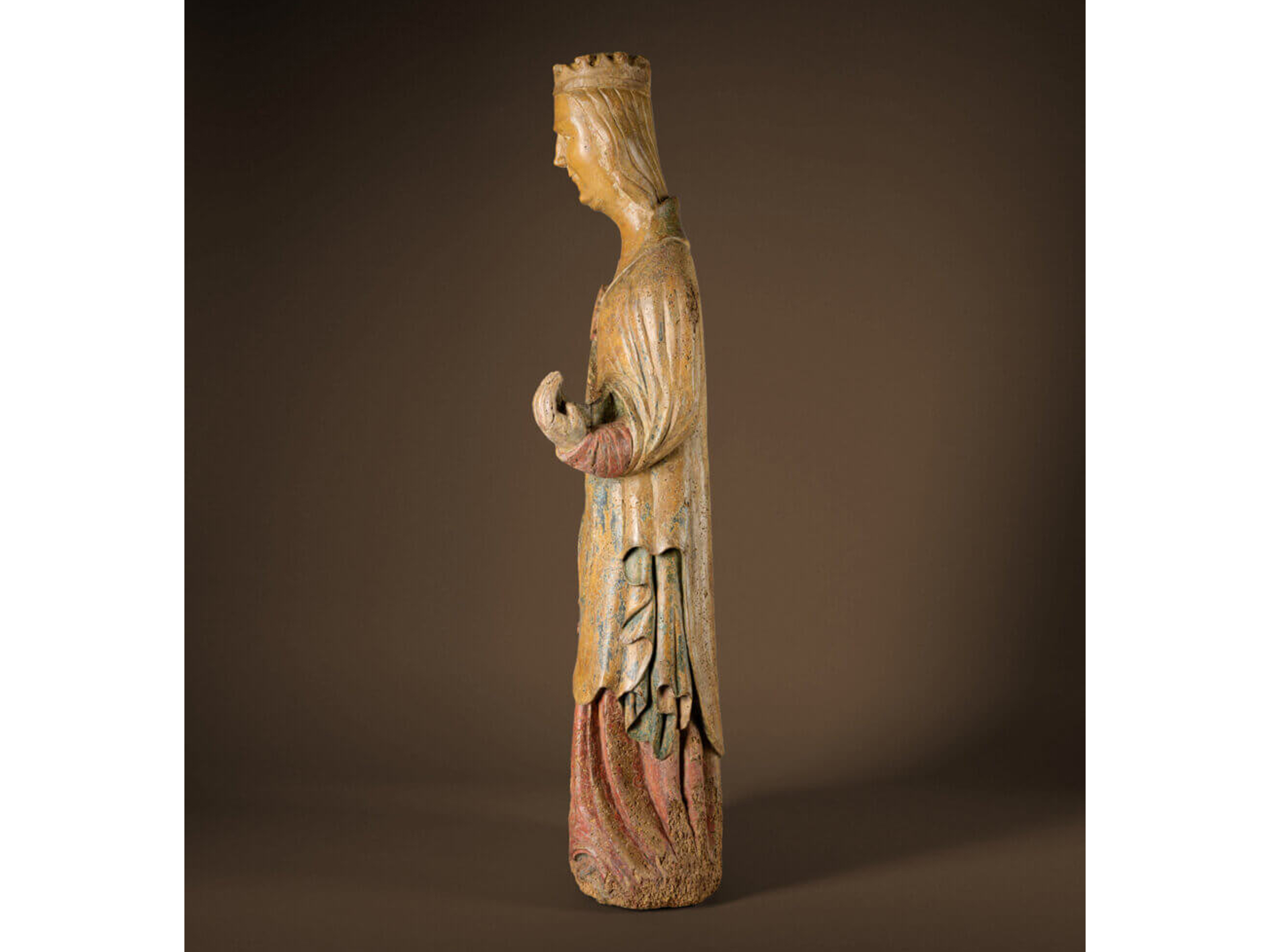
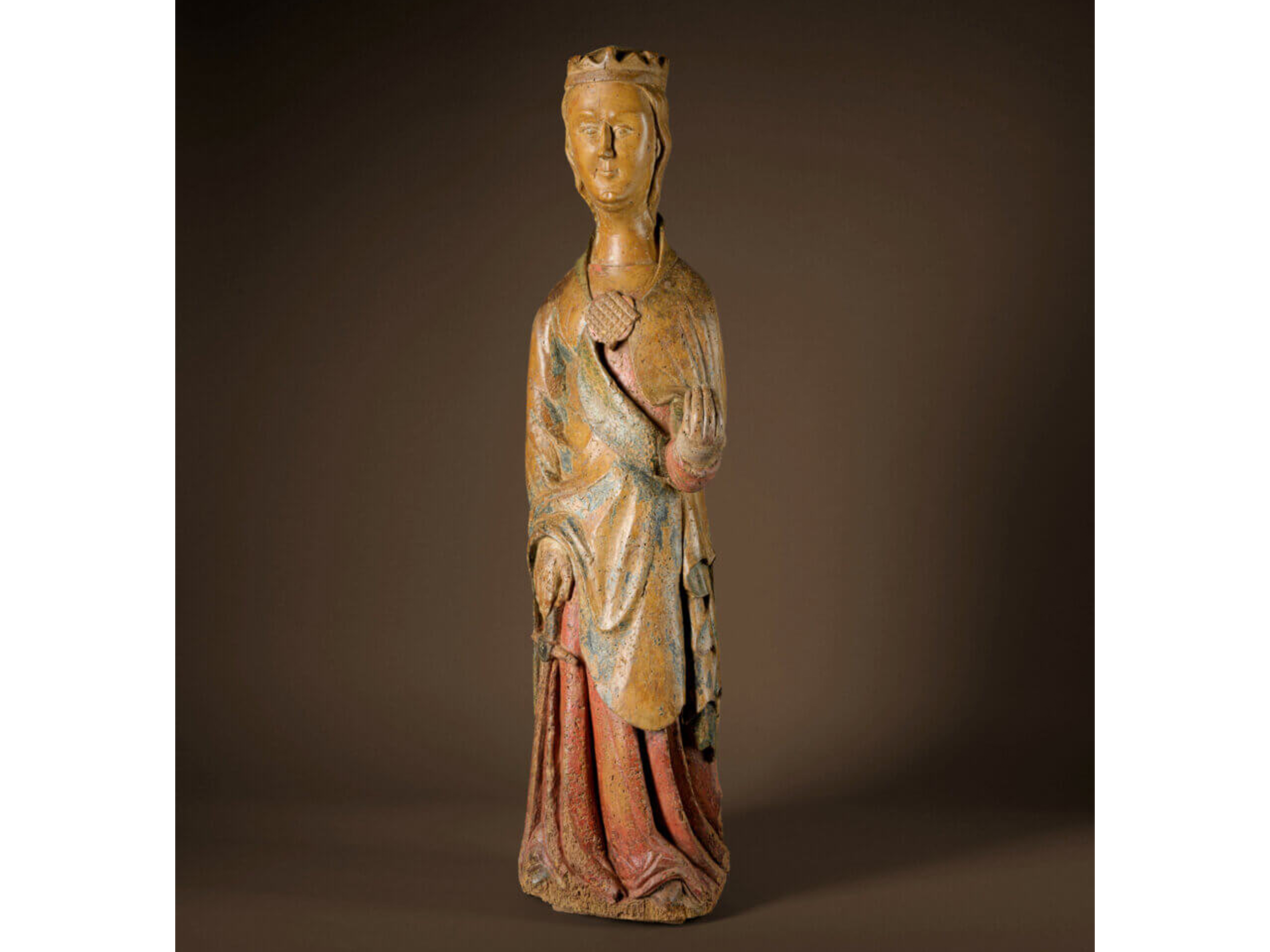
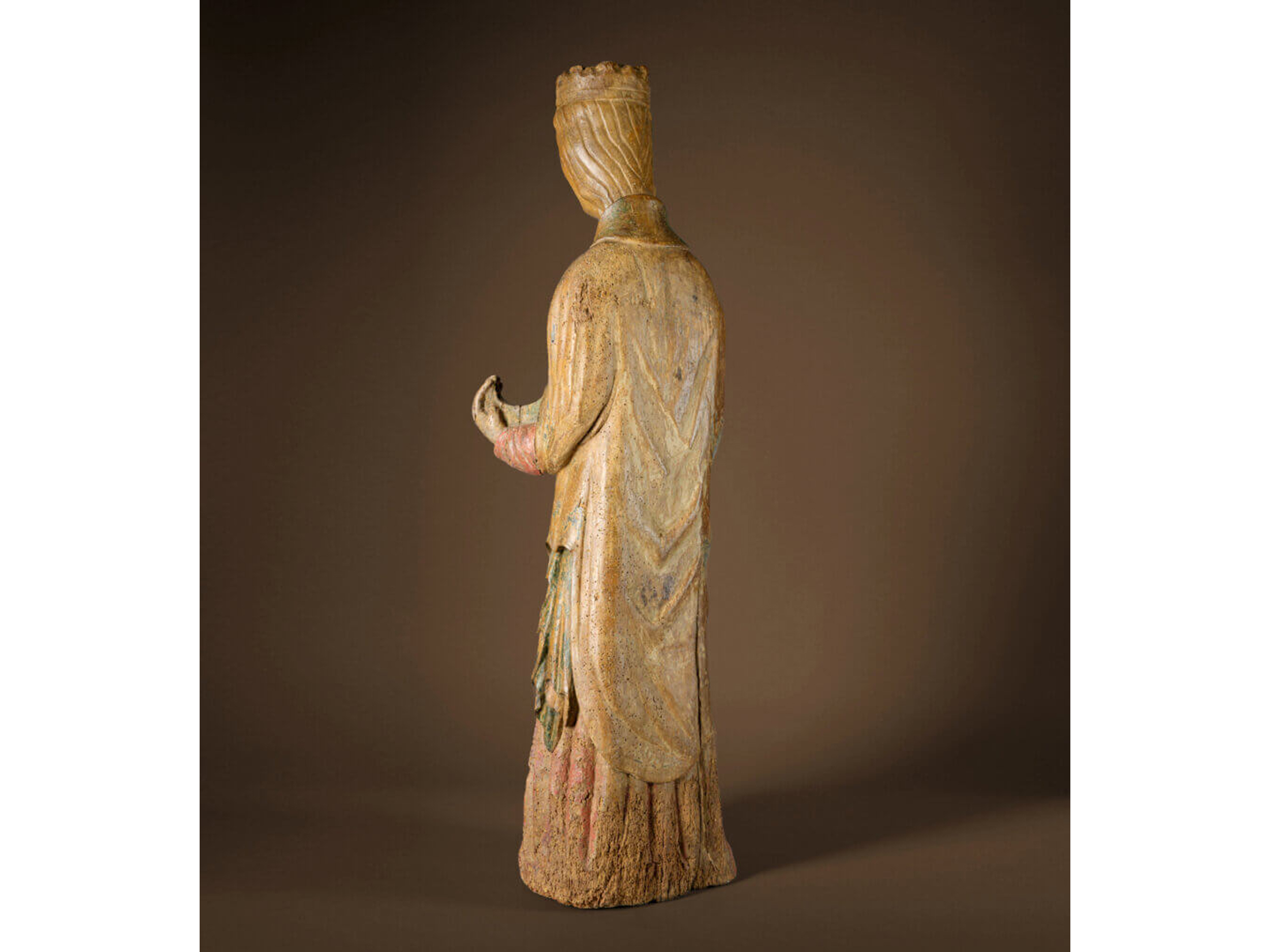
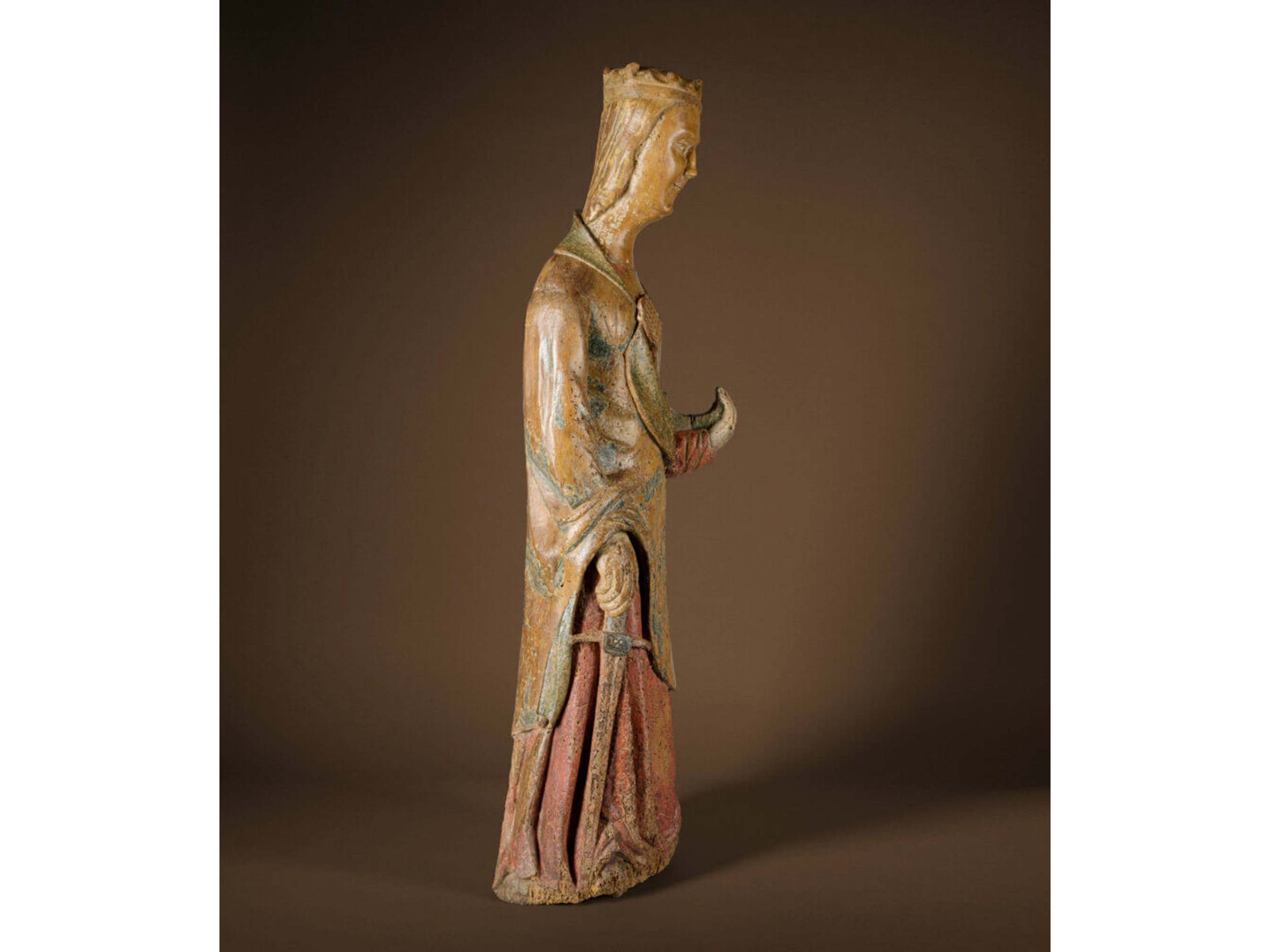
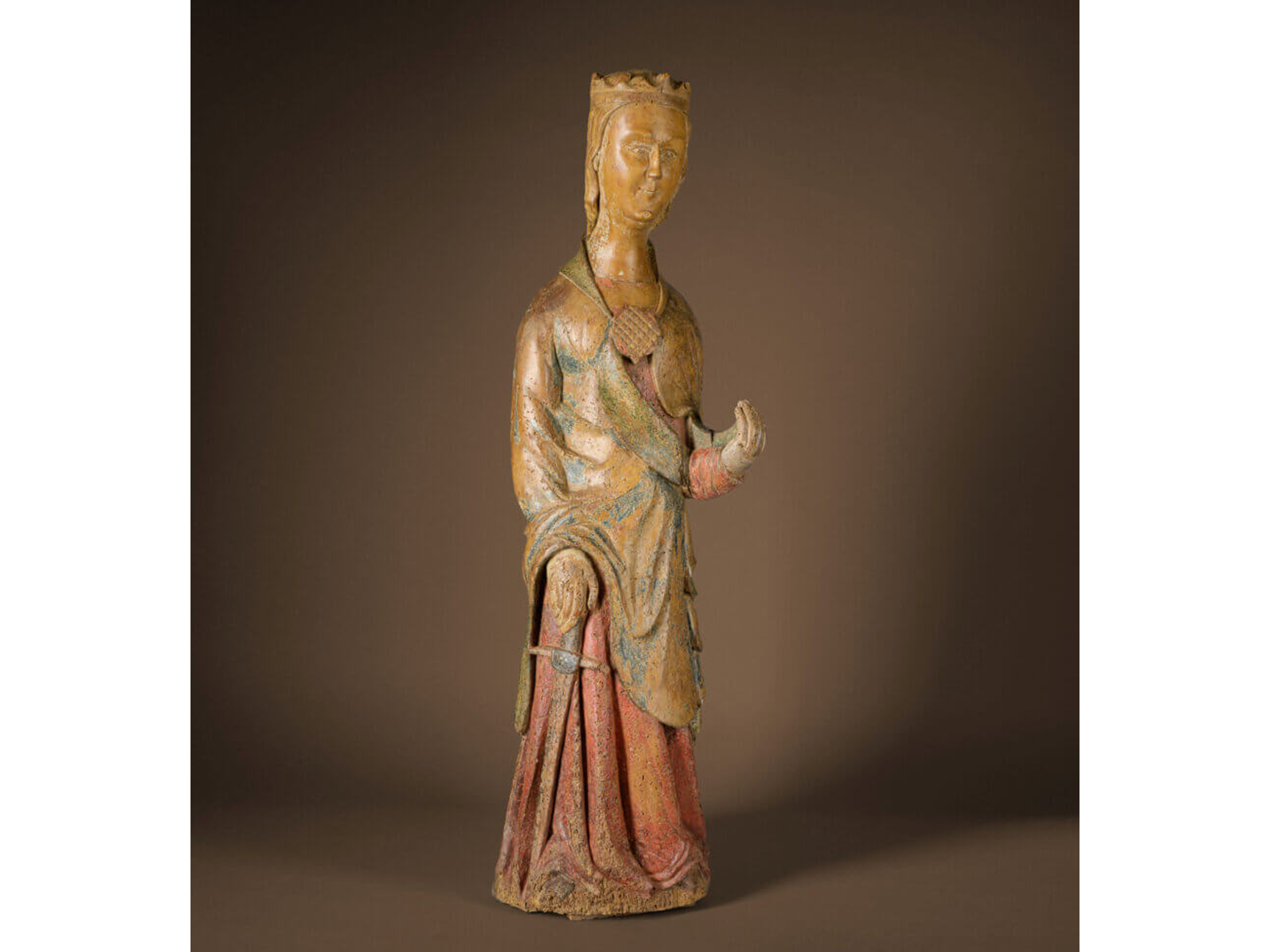
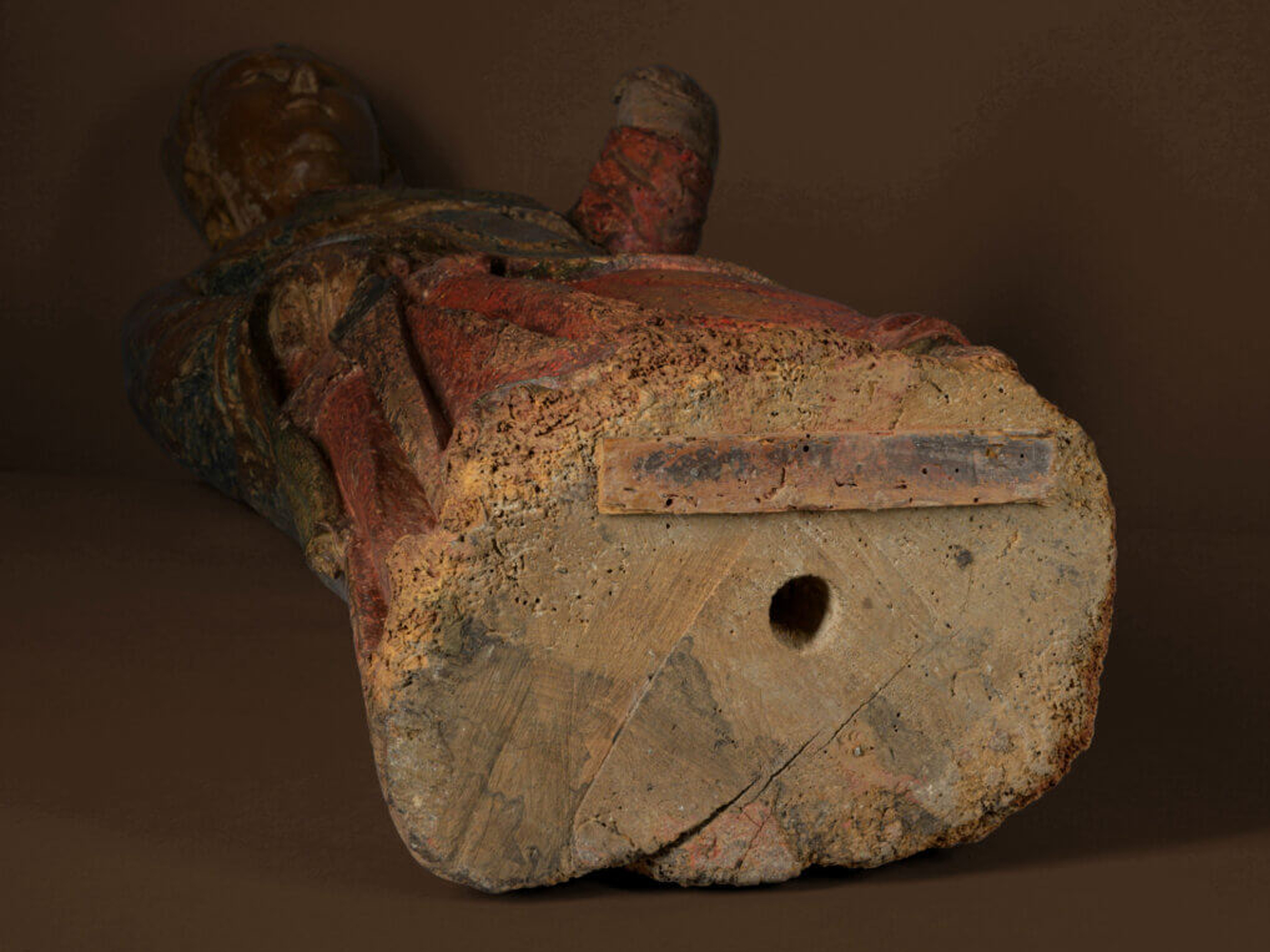
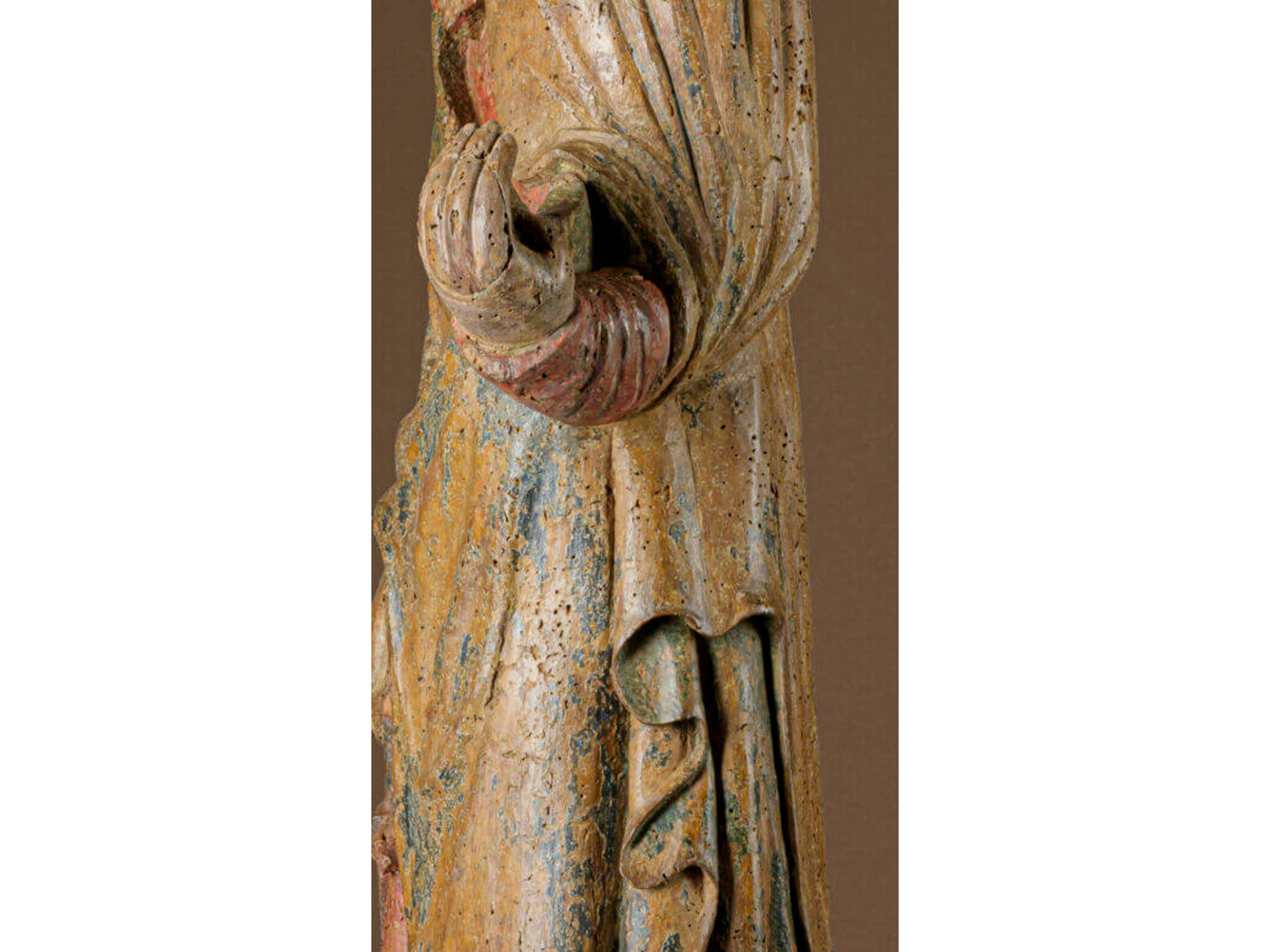
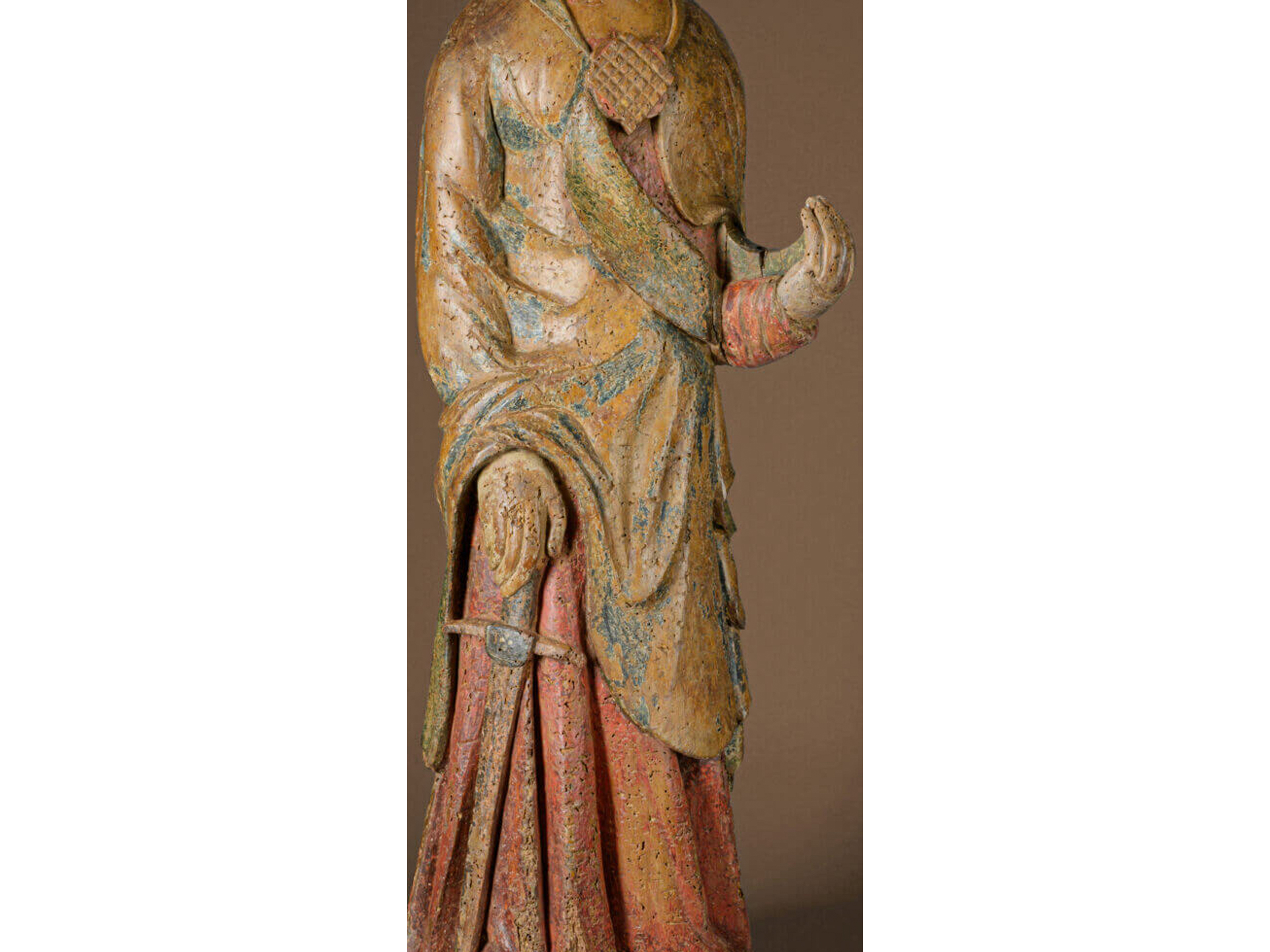
The figure in the museum is particularly notable for its height of 99 cm and the choice of material. Romanesque wooden figures are surprisingly rare in the Alpine region. While Romanesque fragments, reliefs, and figures are usually preserved in stone, this is a freestanding sculpture carved from fine walnut wood in the full-round style. This emphasizes the all-around visibility of this extremely early depiction of Saint Catherine. The sculpture stands upright and is characterized by long, slender proportions and a towering stature. This is underscored by the elongated, elegant neck and skillfully reflects the typical verticality of Romanesque sculptures. In her left, bent hand, she holds the wagon wheel. With her right hand, she grasps the hilt of the long sword with a broad blade, the tip of which nearly touches her foot. These are Saint Catherine’s typical attributes, alluding to her martyrdom, and these unmistakable identifying features clearly identify the figure as Saint Catherine.
A wide crown band rests on Catherine’s oval head, identifying her as a king’s daughter. Beneath it, curly hair cascades gently downward, perfectly framing her prominent, convex face with its small ears. The high forehead reflects a particular ideal of beauty, according to which women shaved the hair above their foreheads to achieve a higher hairline. The highly symmetrical face is characterized by sharply defined brow ridges that flow into a prominent nose with a straight bridge. The elongated philtrum leads to a mouth curved into a mischievous smile and a small chin with a central dimple.
Particularly captivating is Catherine’s expressive eye area: her closely set, deep-set, almond-shaped eyes with pronounced upper and lower eyelids give her gaze an especially alert and proud appearance. At the same time, her face exudes a youthful, majestic vitality that causes viewers to pause.
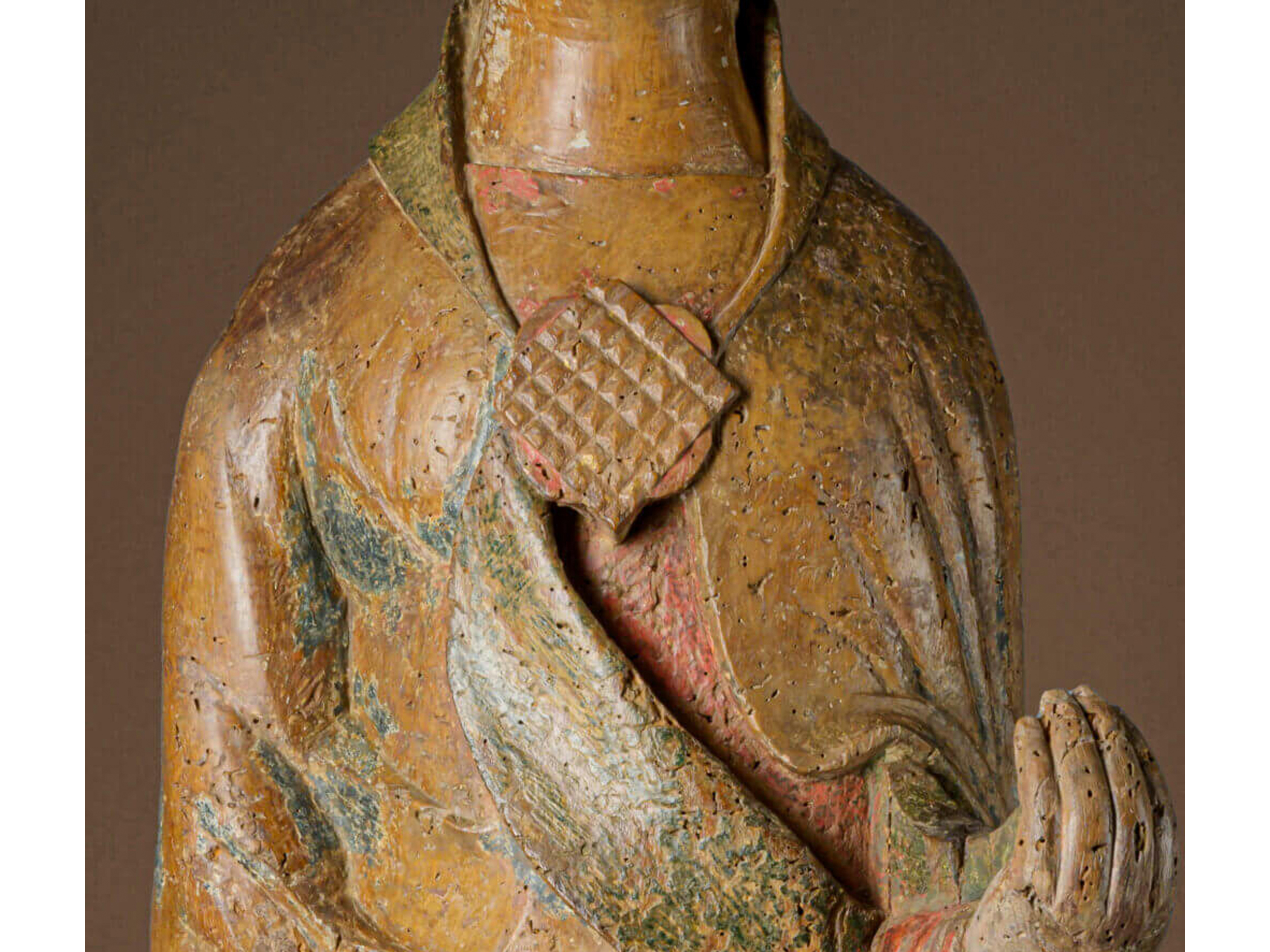
The martyr’s luxurious attire also underscores her significance: a heavy cloak with a stand-up collar flows down her body to her knees and is held together across her chest by a large diamond-shaped brooch reminiscent of Roman fibulae. The dress beneath it also falls in thick, diagonal folds to the hem. Catherine wears simple pointed shoes that peek out from beneath the fabric. What is particularly intriguing here is the interplay of the drapery: while the outer garment rests against the body in a soft, flowing, form-fitting manner, the more voluminous undergarment contrasts with deeper, parallel folds that lend the figure a sense of physicality. This forms a compositional counterpoint to the elongated upper body and the left hand, which reaches out to present the attribute to the viewer. The folds also playfully emphasize certain features of the figure; for example, the flat, diagonally folded pleat above the chest, which directs the viewer’s gaze toward the outstretched left hand, or the cluster of folds directly below it, directed in the opposite direction, which frames Catherine’s right hand and thus highlights the second attribute.
The Romanesque period is characterized by a high degree of stylization in its figures, and this depiction of Catherine is also clearly rooted in the style of that era in its overall conception. The elongated proportions do not reflect realism but rather a perspective rooted in meaning. The head is usually depicted larger in relation to the body; this is part of the archaic posture and facial expressions, which draw on late antique and Byzantine models. The symbolically unambiguous depiction, with an emphasis on the central attributes for easy recognition, as well as a flat treatment of the surfaces—as seen, for example, on the cloak—are further typical characteristics of the Romanesque period. Good comparisons can be drawn with French sculpture from the second quarter of the 12th century as well as with West Alpine sculpture. A suitable comparative work here is the relief of the Last Judgment on the west tympanum of Saint-Lazare Cathedral in Autun, Burgundy, by the sculptor Gislebertus, who created it around 1120–35. Similar characteristics include the parallel, downward-running bowl folds that lie close to the body and the doughy drapery of the fabric. An extremely striking comparison is provided by a group of figures depicting the Holy Family in a stone relief dating from between 1100 and 1150, which has been preserved on the façade of the pilgrimage church of Maria Schnee in Obermauern, East Tyrol. Here, there is a striking resemblance in Mary’s physiognomy, characterized by her pronounced almond-shaped eyes and the vertical nose-to-mouth axis with a central dimple.
Furthermore, the fleshy folds on the side and the diagonal longitudinal folds above the Madonna’s feet bear a close resemblance to those of Saint Catherine.
Not least remarkable is the sculpture’s original polychrome paint scheme, which has been preserved. Until the Late Gothic period, sculptors were also painters who applied color and gilding to their carved figures themselves. By comparing the color nuances with chemical analysis, the three predominant colors—the blue of the outer side of the cloak, the green of the inner side of the cloak, and the red of the dress—can be identified: The blue is presumably mountain blue or azure; the green was likely derived from Tyrolean green earth; and the red was most likely produced from bright cinnabar. The blue pigment is derived from azurite and is considered one of the most important and expensive pigments of all, as lapis lazuli had to be imported from Afghanistan. The pigment derived from “Grüne Erde,” which varied by region, was already in use in antiquity, primarily for wall paintings. Cinnabar was used as early as thousands of years before the birth of Christ and is particularly notable for its opacity and luminosity, which are also clearly evident in this sculpture.
These symbolic colors were not chosen at random. Blue, the divine color associated with the heavens, was regarded from the 12th century onward as the color of chastity and therefore, in particular, as the color of Mary, who from that time onward was often depicted wearing a blue cloak over a red dress. As a result, this depiction of Saint Catherine also appears to be inspired by the popular Marian color scheme. Here, the red is an expression of symbolic authority, a tradition adopted from late antiquity. It is also often regarded as the color of martyrdom. The green here could symbolize love and hope. These magnificent colors appeared particularly vibrant in combination with the gilded brooch and the oil-gilded hair, remnants of which have also been preserved.
Overall, this museum-quality sculpture exudes a majestic, self-assured demeanor; it is in an exceptionally well-preserved state for a wooden work, with traces of the original polychromy still visible, and possesses a lovely expressiveness that lends this Romanesque sculpture a supple grace and makes it appear lifelike to the viewer.
I hereby place a purchase order for the exhibit listed below at the purchase price stated below.
Login
Login
Bid form
With this purchase order, I authorize TIBERIUS AUCTIONS to bid in my name and on my account up to the specified purchase limits or to contact me for a telephone bid during the auction.

Subscribe to our newsletter to be informed about upcoming auctions.