Angel of the Annunciation
TIBERIUS – DIRECTSALE
Selling price
€ 76.800
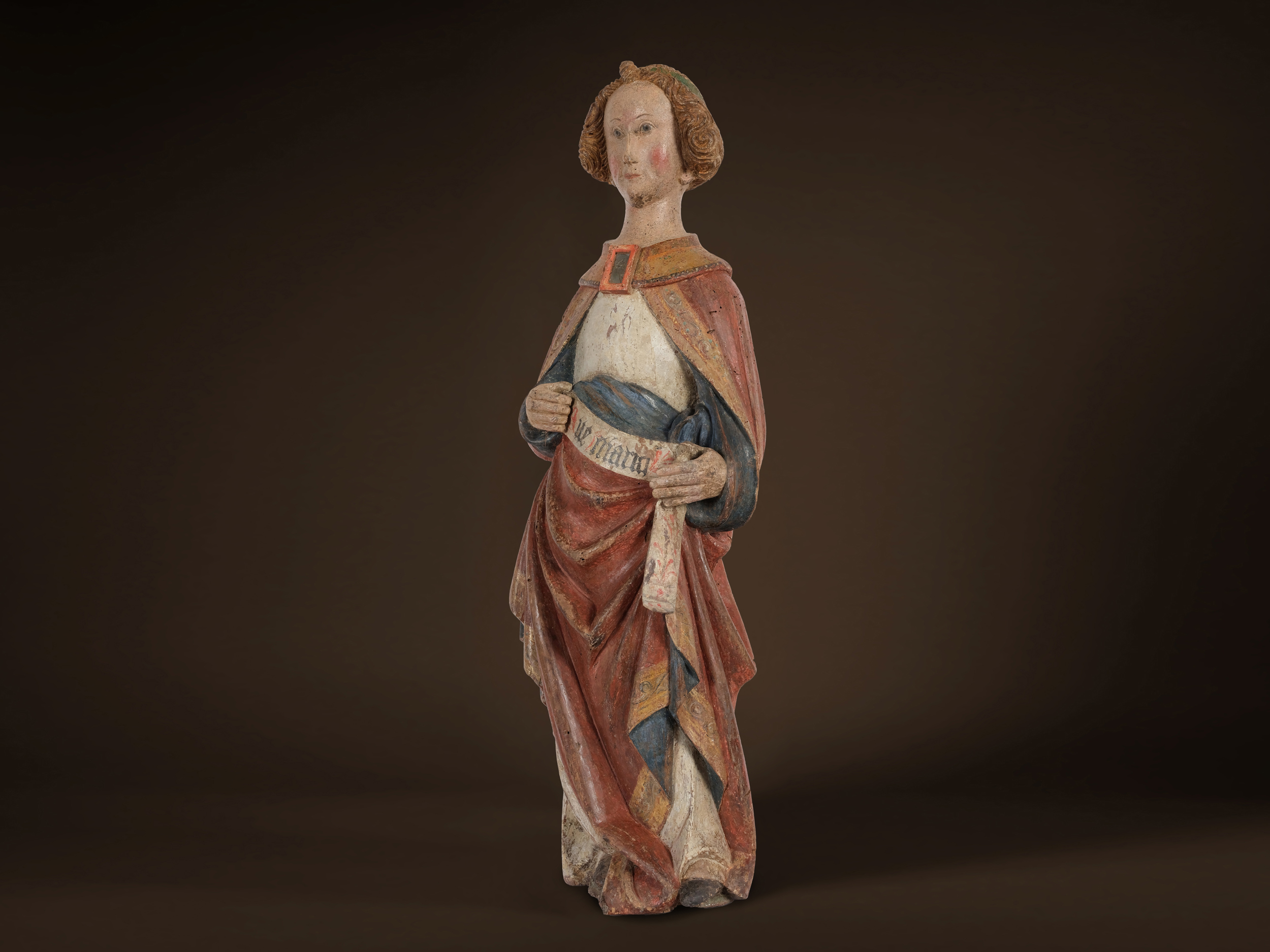
Angel of the Annunciation
Prague workshop within the Circle of Master Theoderich
(mentioned from 1359 to 1368)
c. 1380/90
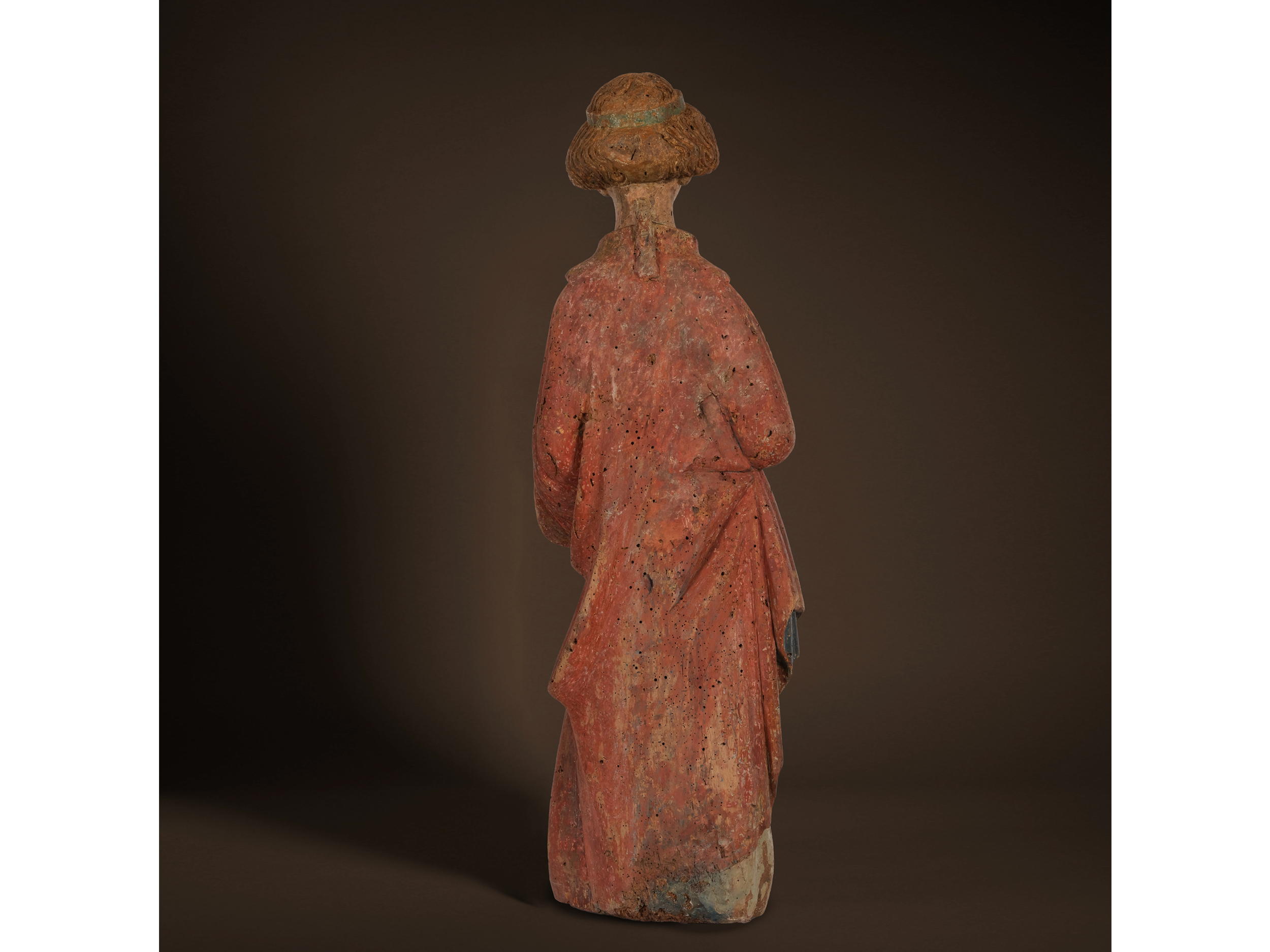
Carved from linden wood and polychromed
Height 88 cm
An Angel of the Annunciation—A Masterpiece of Gothic Sculpture from the Prague Circle
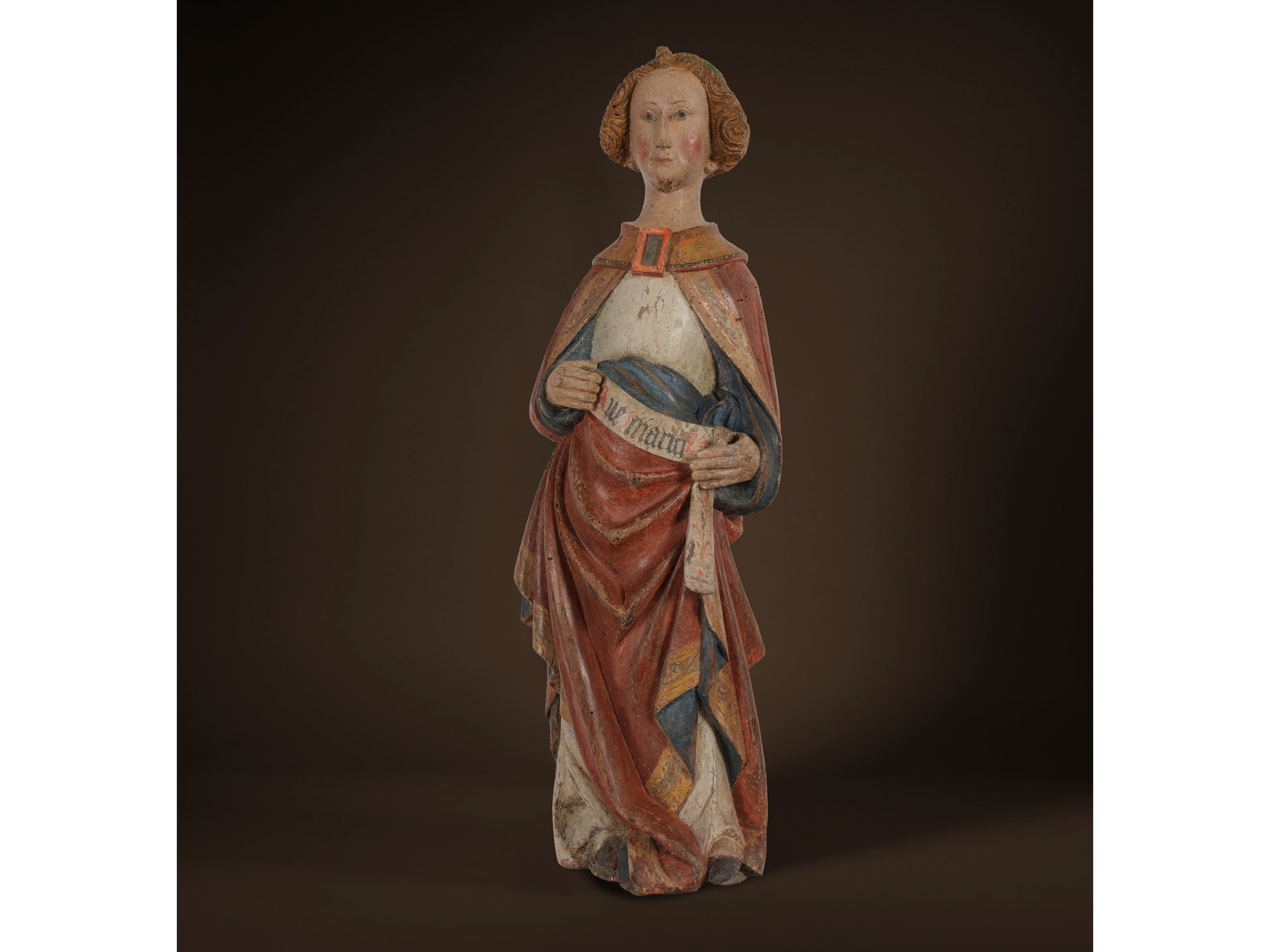
This impressive sculpture of an Angel of the Annunciation is an outstanding example of museum-quality Gothic art. It was created around 1380/90 in the Circle of Master Theoderich in Prague—one of the leading artistic centers of Central Europe at that time—and represents an exceedingly rare treasure. Its art-historical significance lies not only in its masterful execution but also in its connection to one of the most fascinating workshops of late medieval art.
Master Theoderich and His Artistic Circle
Master Theoderich was a key figure in the Gothic art movement in Prague during the 14th century. As court painter to Emperor Charles IV, he played a decisive role in shaping the artistic decoration of St. Vitus Cathedral at Prague Castle. His influence extended far beyond panel painting: Theoderich’s workshop was most likely a vibrant center of collaborative creativity, where painters, sculptors, and artisans worked closely together. It is quite conceivable that sculptors from his school also contributed to the architectural and sculptural masterpieces that defined Prague’s sacred and imperial representation.
The Angel of the Annunciation in Detail
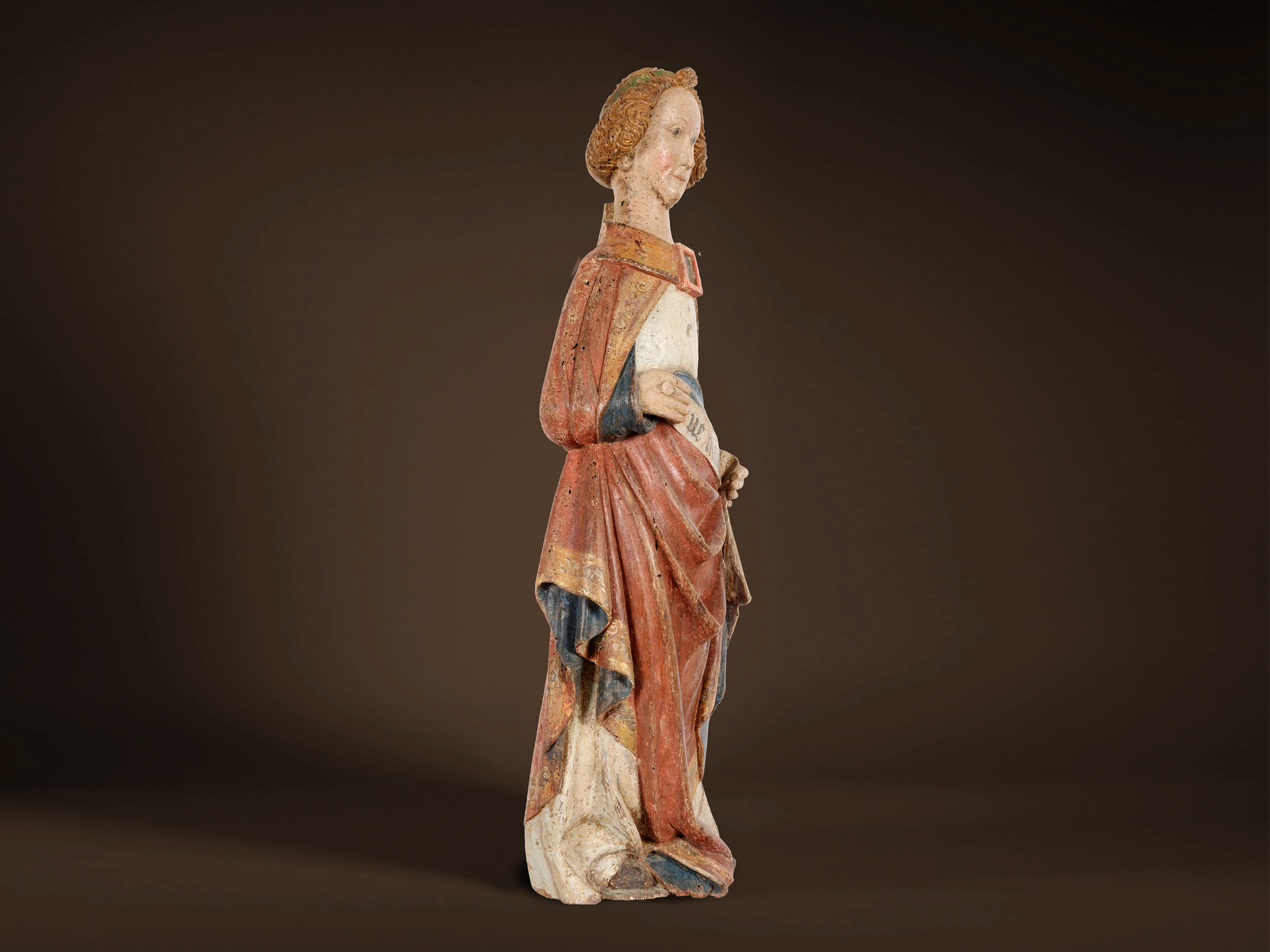
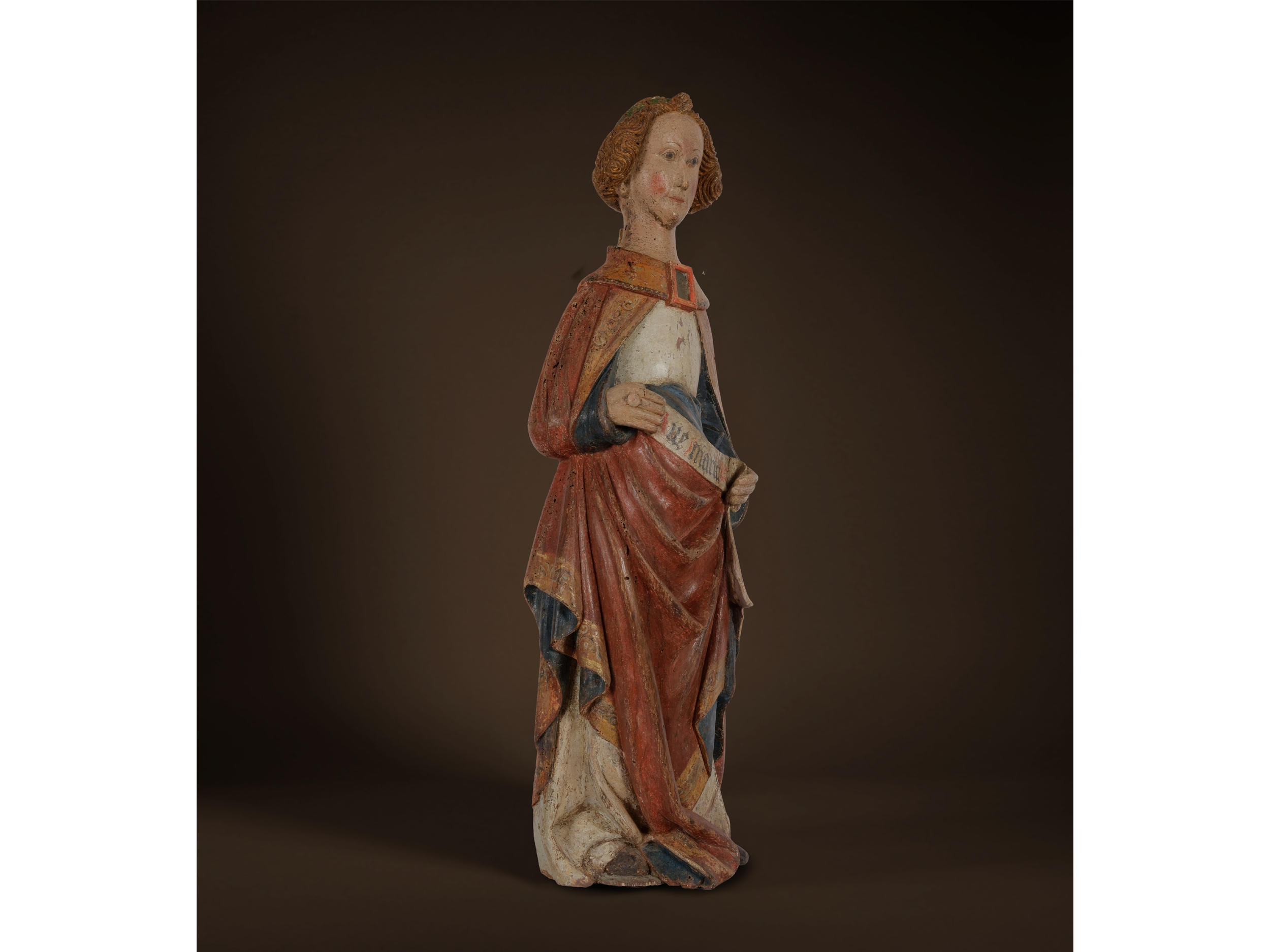
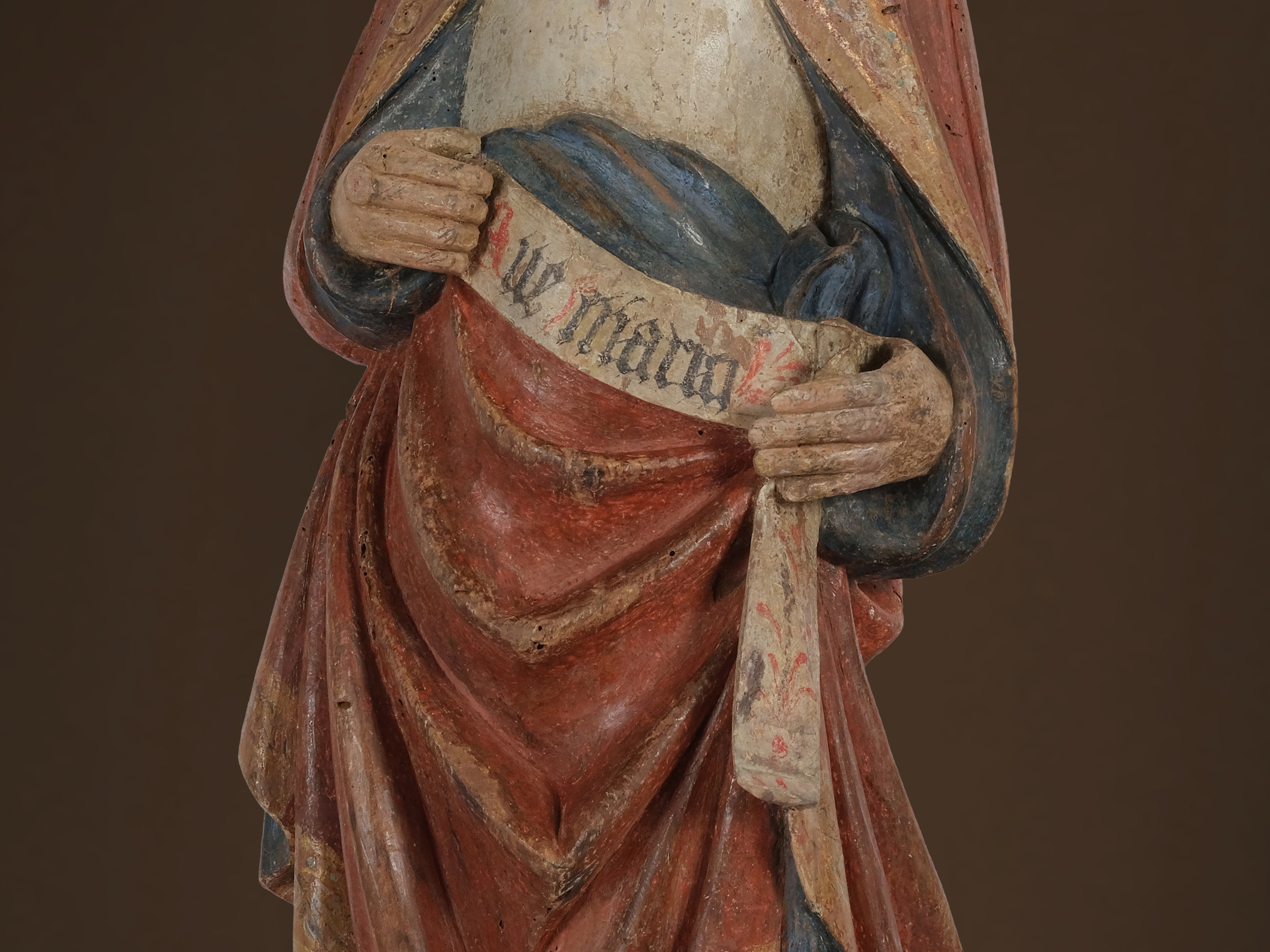
The sculpture depicts an angel standing upright, holding a scroll in his hands on which the words “Ave Maria” can be read. This greeting to the Virgin Mary refers to the biblical scene of the Annunciation (Luke 1:28) and identifies the figure as a supernatural messenger of God—an angel announcing the birth of Christ to Mary. The Angel of the Annunciation is the Archangel Gabriel, who appears in Christian tradition as a divine messenger. He plays his most famous role in the scene of the Annunciation (Luke 1:26–38): With the words “Ave Maria, gratia plena,” he greets her as God’s chosen one. Gabriel is usually depicted as a youthful, graceful angel, often holding a scroll or a lily as a symbol of purity.
Particularly striking are the characteristic stylistic features that reveal a close connection to the art of Master Theoderich: the short curls reaching down to the ears, with the central lock resting above the high forehead, are inevitably reminiscent of the figures that appear in the master’s panel paintings. The finely modeled facial features—the large, round eyes, the straight nose, and the delicate mouth—reflect the naturalistic portrait style that was becoming increasingly prevalent in Prague’s artistic circles in the late 14th century. The delicately flushed cheeks lend the figure additional vitality and warmth.
A remarkable comparison can be drawn with the depiction of Saint Vitus, which is located in a window niche of the Chapel of the Holy Cross at Karlštejn. There, too, the distinctive hairstyle with a central tuft is evident, just as it is in the depiction of Saint Louis of France above the south portal of the same chapel. The artful styling of the hair into dense, voluminous curls is a typical hallmark of Prague art from this era—impressively demonstrated by the so-called Madonna of Veveří.
Here, the angel appears as a youthful yet contemplative figure—a symbol of divine message and heavenly presence. The pose and the scroll bearing the “Ave Maria” are clear iconographic references to his role in the Annunciation.
Garments and Drapery as a Reflection of Gothic Fashion
The angel’s garment reflects the fashion trends of the late 14th century: beneath a long, generously draped fold of the cloak, the figure wears a simple white tunic. The cloak is fastened below the neck with a striking clasp, which may once have been adorned with gemstones—a reference to his otherworldly origin and exalted function. The powerful folds of the cloak—ranging from angular to softly curved box pleats—attest to the sculptor’s masterful ability to bring movement and the quality of the fabric to life. Particularly striking are the so-called “doughy” drapery folds, which characterize the “soft” or “international” style that flourished in Prague around 1400.
The Prague Context—Center of Gothic Art
This sculpture fits into the stylistic development of angel depictions in the late Middle Ages: from earlier, often static and uniform forms toward more individualized and expressive figurative representations. The carefully designed clothing, the emphatically expressive facial features, and the sculptural rendering of the folds in the robe reflect the innovative spirit associated with Master Theoderich’s workshop.
Under the patronage of Emperor Charles IV, Prague experienced an artistic golden age. The city emerged as a center of Gothic art, where religious works not only served devotion but also underscored Prague’s growing status as a cultural and political metropolis. The close intertwining of piety, claims to power, and artistic expression is impressively evident in works such as this sculpture.
It is conceivable that the angel figure was created as part of the Prague court’s ambitious artistic endeavors—as part of a comprehensive program to present the city as the new “Rome of the North.” Theoderich’s workshop played a central role in these efforts: with its high-quality devotional images and sculptures, it left a lasting mark on Prague’s sacred landscape. The angel of the Annunciation, bearing a banner inscribed with “Ave Maria,” fits perfectly into this context, in which imperial power, religious devotion, and artistic innovation were closely intertwined.
Bibliography
Jiří Fajt & Jan Royt, Magister Theodoricus. Court Painter to Emperor Charles IV. The Artistic Decoration of the Sacred Spaces at Karlstein Castle, Prague 1997.
Gustav E. Pazaurek, “Theoderich,” in: Allgemeine Deutsche Biographie 37, Leipzig 1894, pp. 708–710.
Login
Hiermit stelle ich einen Kaufauftrag für das unten angeführte Exponat zum unten angeführten Kaufpreis.
Login
Registrieren
I hereby place a purchase order for the exhibit listed below at the purchase price stated below.
Login
Login
Bid form
With this purchase order, I authorize TIBERIUS AUCTIONS to bid in my name and on my account up to the specified purchase limits or to contact me for a telephone bid during the auction.
Subscribe to our newsletter to be informed about upcoming auctions.