
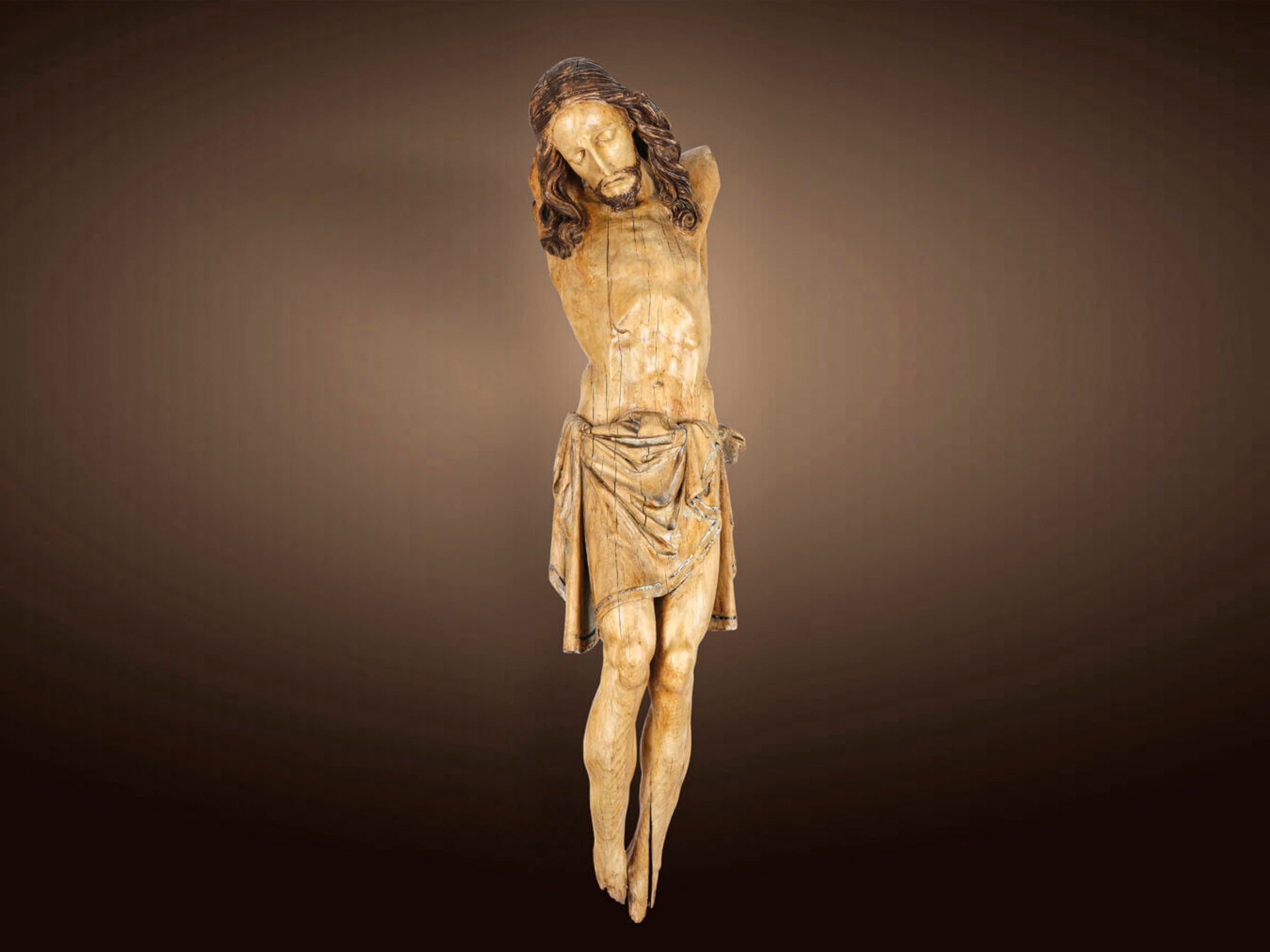
Monumental Christ
TIBERIUS – DIRECTSALE
Selling price
€ 23.000
Monumental Christ
Styria
c. 1490
Carved from linden wood
Traces of polychromy
Height 150 cm
About the life-size crucifix
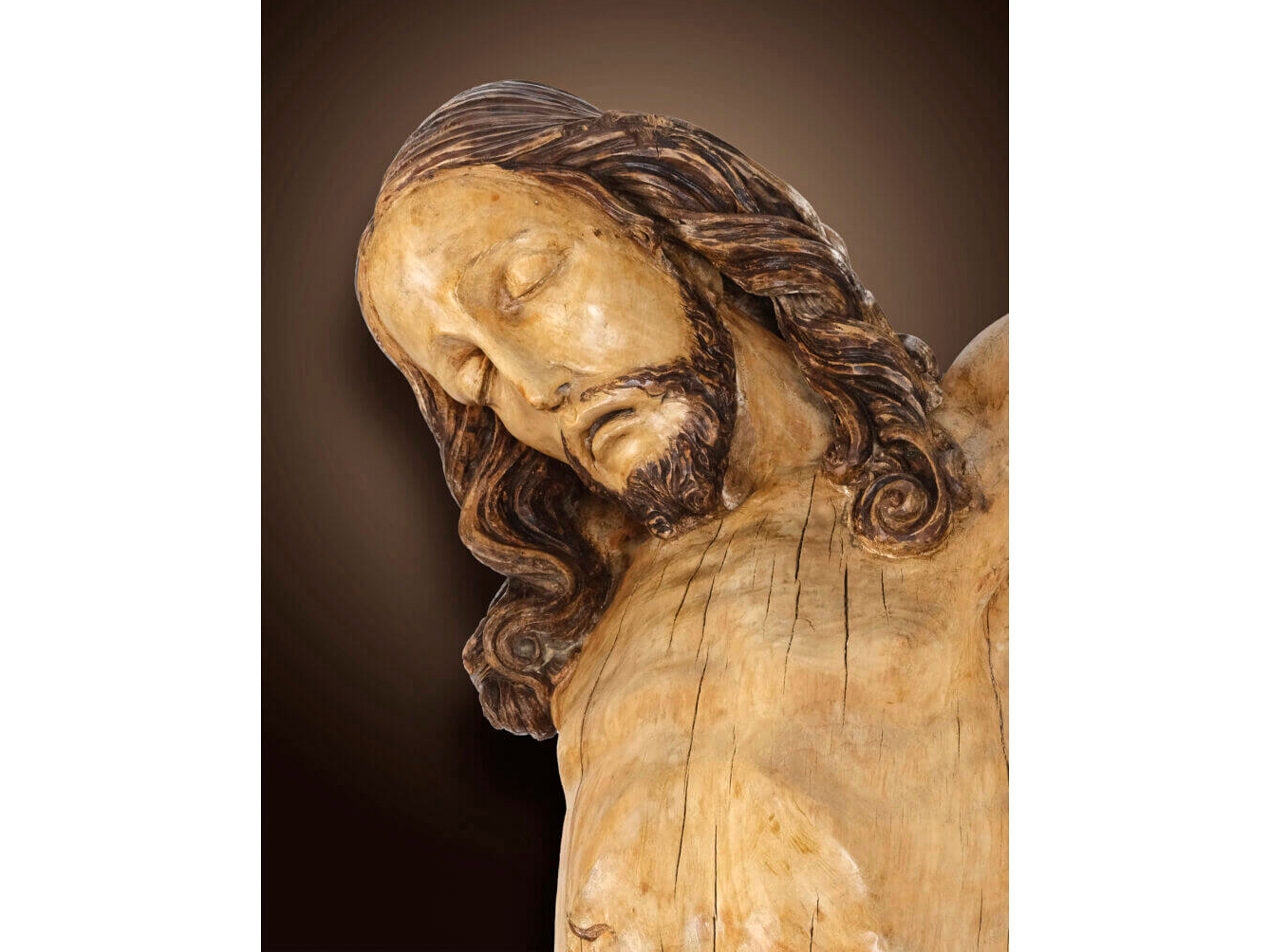
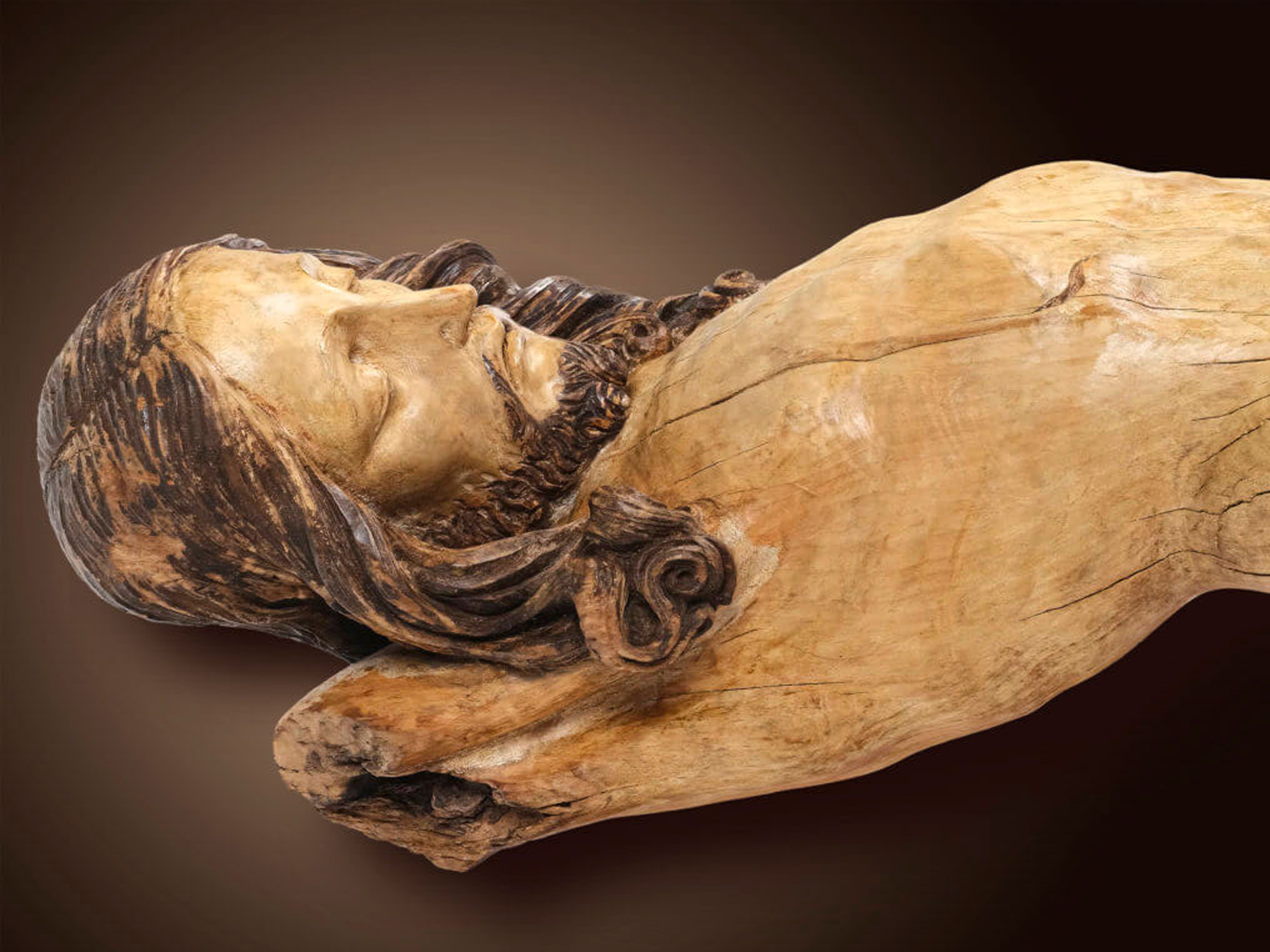
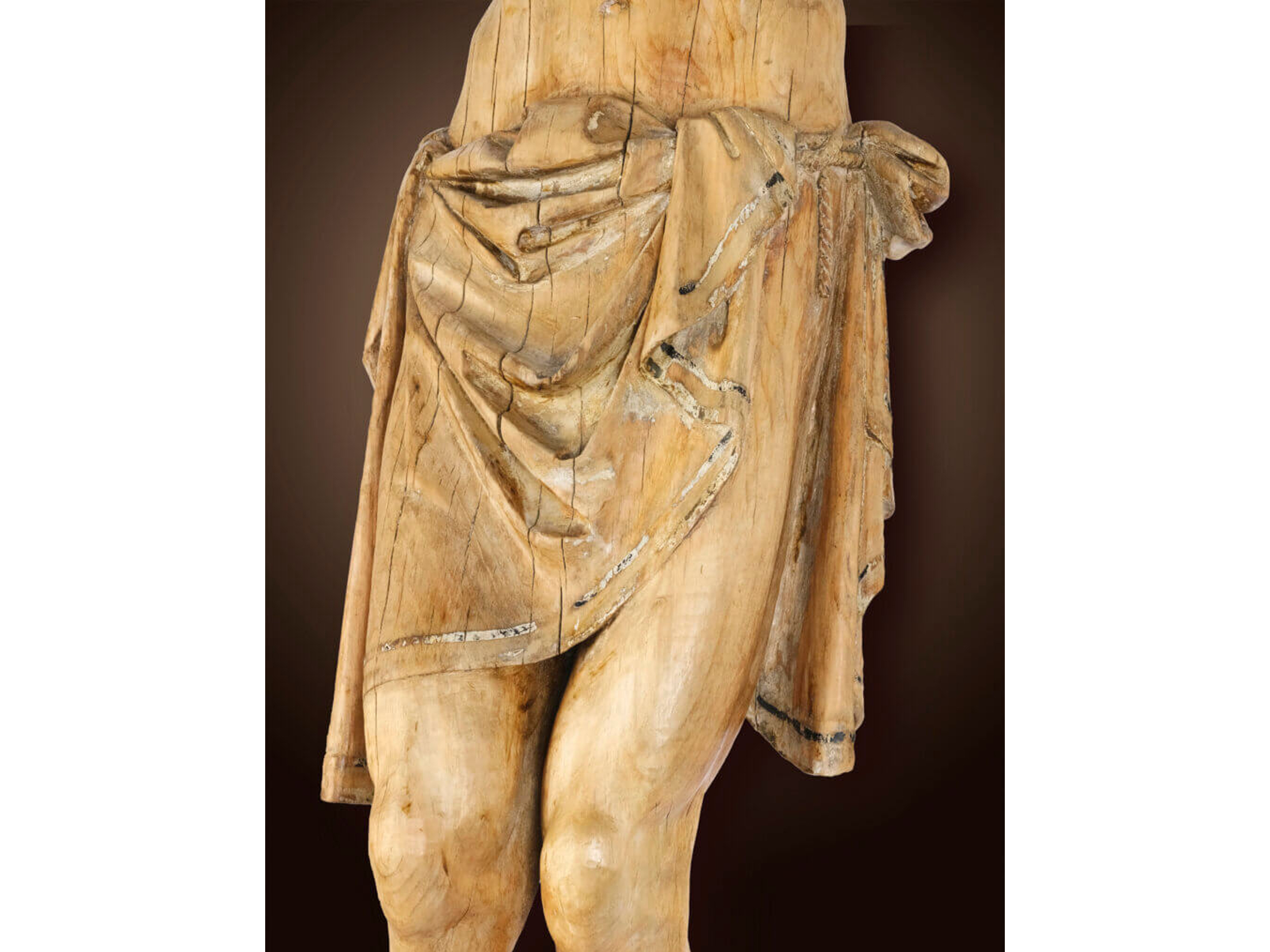
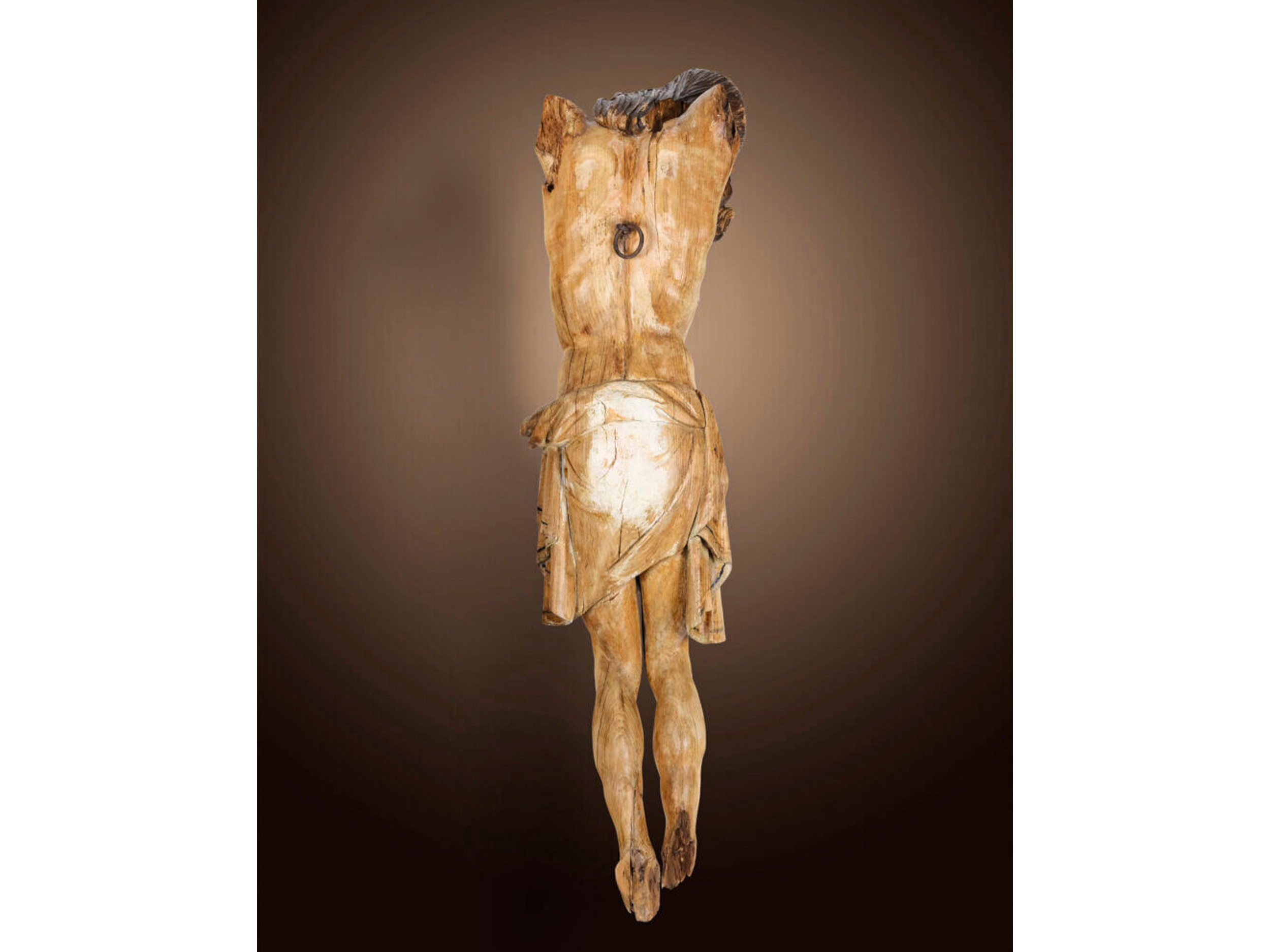
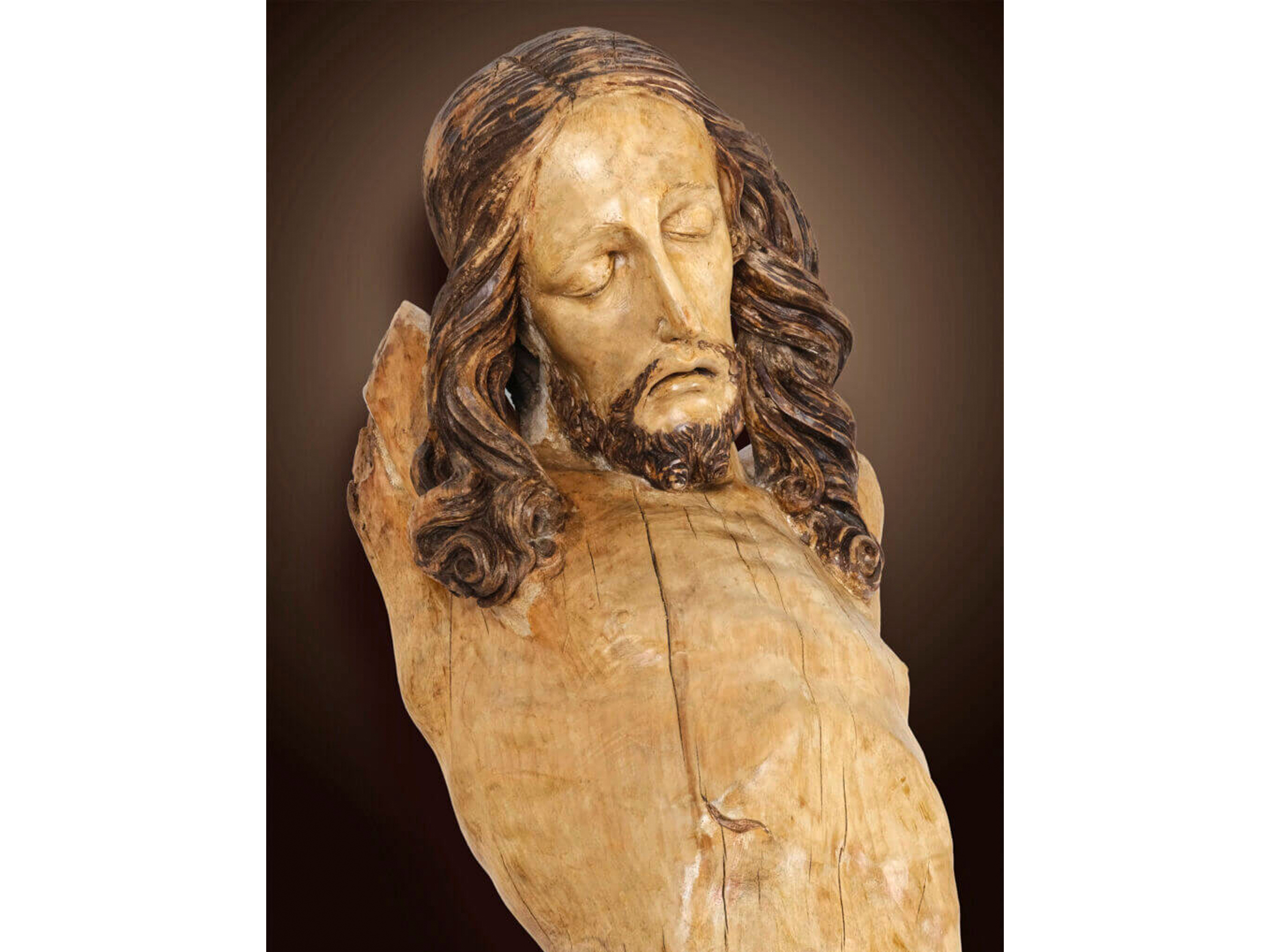
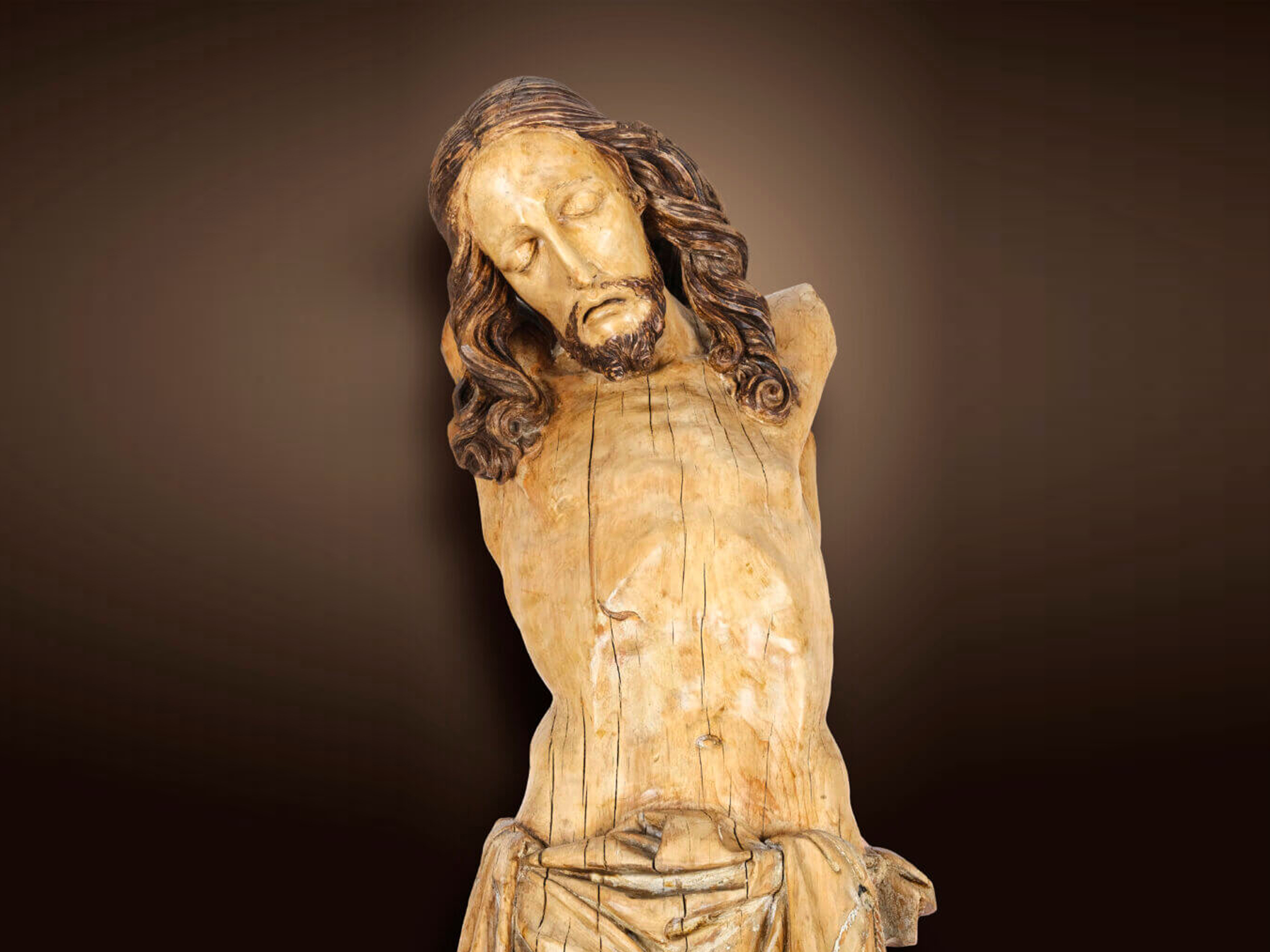
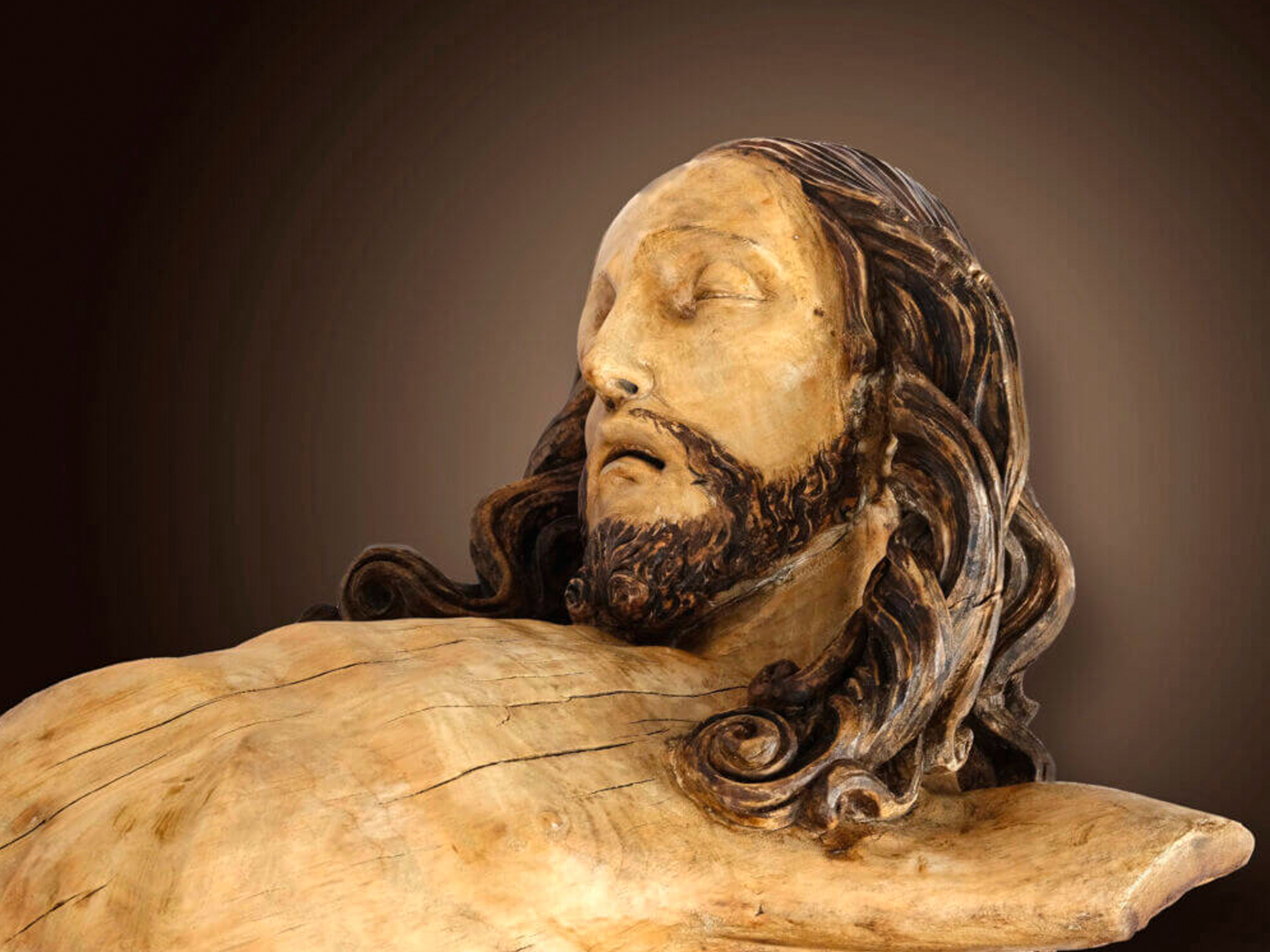
With its “sack”-like, drooping corpus—whose left shoulder joint suggests that the arms were originally intended to be depicted in a diagonally ascending pose, and which is also missing its feet— what is particularly striking is the subtle formal interpretation of the flesh tones and the ribbed articulation of the strands of hair—captured in its sculptural surfaces—which are rendered as large, sweeping waves cascading down the sides and—above all—in the physiognomic expression, in which the pain previously endured seems to have settled into a frozen calm. In striking contrast to the emphatically vertical posture of the body—whose axial alignment is given a tension-filled nuance by the gentle tilt of the upper body to the left and in harmony with the parallel positioning of the legs—the head, tilted to the left, with its intense facial expression in the strikingly forward-leaning pose, reveals—despite the subject’s “state of death”— a distinctly vital and at the same time expressive element in the sculptural realization. It is precisely this articulated tilt of the head, in conjunction with the anatomically precise rendering of the ribcage and the musculature around the parallel knees, that lends this sculpture that expressive tension—a quality that grants this crucifix its obvious “special status” compared to numerous thematically similar carved works. Between the “anatomically” accurate depictions of the chest and the legs, the loincloth—with its pointed, parabolic, downward-pressing folds and the drapery ends hanging down at the sides of the hips—creates a restless contrast, much like the one to the lively “condensations of form” in the hair on the head. Incidentally, both the latter and the former are the only areas within this sculpture where remnants of the presumed polychromy can be found in varying degrees. Similarly, the “undulating” surface of the chest clearly distinguishes the area of the heart and lungs in contrast to the sunken pit of the stomach—and the strikingly linear lance wound precisely at the right costal arch, by virtue of its suddenness, serves as an effective counterpoint to the “noble, smoothed” flesh tone— this artistic methodology culminates in the physiognomy, where the high, “dome-shaped,” gracefully curved forehead, in harmony with the widely arched eyebrows and their continuous transition to the long nose—in coordination with the deep-set eye sockets and their almost completely closed eyelids, which are rendered in stereometric curvature—as well as the “spherically curved” cheeks in the upward-curving “crescent moon”-like mouth, separated by the beard, the “agony of death” previously endured—now “at rest”—is expressed in a restrained synthesis.
Although numerous narrow cracks of varying lengths can be observed throughout the entire corpus within this monolithic block of wood—suggesting that the figure was likely exposed to the open air for extended periods—the absence of such cracks on the head is explained precisely by the head’s pronounced tilt, which effectively served as a “shield”-like protection! As much as the repeatedly mentioned tilt of Christ’s head—in this exceptionally striking form and in addition to the intense contrast with the “sack-like” hanging body—may initially seem disconcerting, it is precisely this circumstance that serves as an essential criterion for art-historical classification: In the so-called Styrian “Mühlauer Crucifix” (today in Graz, Alte Galerie des Joanneum, Eggenberg Castle) from the third quarter of the 13th century—which soon inspired follower works—a genuinely Styrian origin is equally unmistakable for the crucifix in question, which represents an unmistakable late-Gothic variant of this type from the final decade of the 15th century. Given the outstanding sculptural quality of the carving, one may assume a prominent social milieu—both on the part of the presumed patrons and, even more so, on the part of the woodcarver who executed the work. To what extent, if at all, the original intended location of this crucifix—the Church of the Holy Spirit in Bruck an der Mur (completed in 1493), co-founded by the Bruck merchant Kornmesser—might be relevant can, at least for the time being, be considered “speculative” at best.
Dr. Arthur Saliger
Login
Hiermit stelle ich einen Kaufauftrag für das unten angeführte Exponat zum unten angeführten Kaufpreis.
Login
Registrieren
I hereby place a purchase order for the exhibit listed below at the purchase price stated below.
Login
Login
Bid form
With this purchase order, I authorize TIBERIUS AUCTIONS to bid in my name and on my account up to the specified purchase limits or to contact me for a telephone bid during the auction.
Subscribe to our newsletter to be informed about upcoming auctions.