

The auction house in Vienna in the heart of Europe
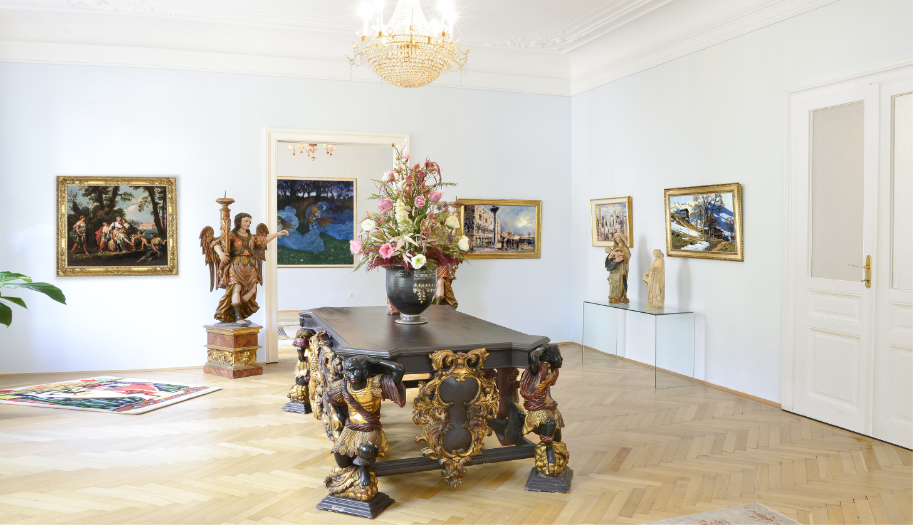
TIBERIUS-AUCTIONS is the online auction house in Vienna. Just a stone’s throw from the imperial Schönbrunn Palace, you will find a rich selection of artworks and antiques from all periods of history in an upscale setting. Quality before quantity is our credo. Several times a year art auctions are held in our auction house. Our offer ranges from paintings of the Old Masters, the 19th century and the great painters of Classical Modernism to notable contemporaries. Sculptures from antiquity, through the Gothic and Renaissance to the sculptors of the 19. & 20th century, exquisite antiques & Kunstkammer objects complete our diverse offer.
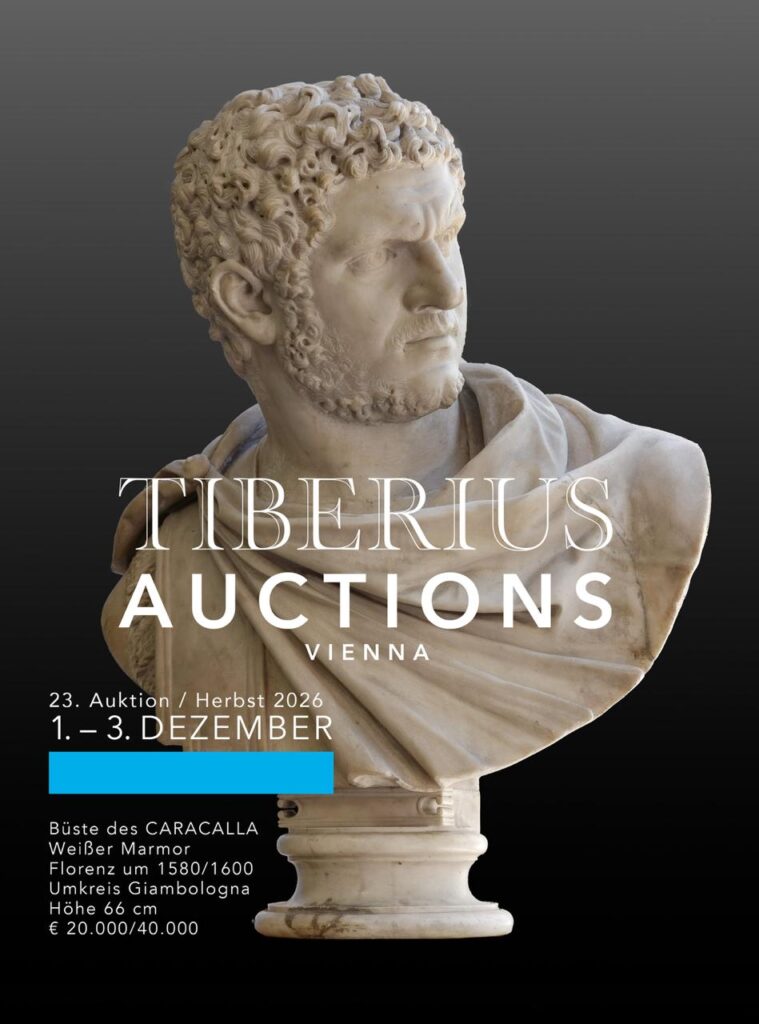
December 1/2/3, 2026, 3:00 p.m.
Mon 4/20
Tue 4/21
Wed 4/22
Thu 4/23
Fri 4/24
Mon 4/27
10:00 a.m. – 4:00 p.m.
10:00 a.m. – 4:00 p.m.
10:00 a.m. – 4:00 p.m.
10:00 a.m. – 4:00 p.m.
10:00 a.m. – 4:00 p.m.
10:00 a.m. – 4:00 p.m.
During the first week of December, from December 1–3, 2026, at 3:00 p.m. each day, we will once again be auctioning a wide variety of extraordinary and unique works of art and antiques from all eras of art history. The highlight is the bust of Caracalla, modeled after the ancient original, which is currently on display at the Museo Capodimonte in Naples. Its life-size scale and outstanding quality make this sculpture a museum-quality piece. Given that it was created around 1600 and its masterful execution, this portrait can be attributed to Giambologna’s circle. Another highlight is the table centerpiece, also known as a “drinking game.” It comes from the Figdor Collection in Vienna and is believed to have been created around 1500 or in the early 16th century. It is made of fire-gilded and silver-plated copper. In terms of style, craftsmanship, and age, it bears a resemblance to the so-called “Schlüsselfelder Ship” at the Germanisches Museum in Nuremberg. You will also find a 12th-century “Sedes Sapientiae” from France and a wide variety of interesting sculptures spanning from antiquity through the Middle Ages to the 20th century. As always, a key focus is on outstanding paintings, antiques, and much more.
Visit our online catalog starting November 10 and register in time to place bids.
We hope you enjoy the upcoming auction.
Your Tiberius-Auctions Team

Portrait bust of the Roman Emperor Caracalla
Circle of Giambologna, 1529–1608
ca. 1580–1600
White marble (probably Carrara)
Height: 66 cm, including contemporary round base
Excellent condition for its age;
the fine surface textures are very well preserved.
€ 20,000 – 40,000
This sculpture is a masterful interpretation of the famous “Farnese type” of Emperor Caracalla. The ancient original was excavated around 1545/46 at the Baths of Caracalla in Rome and, in the second half of the 16th century, became the epitome of the expressive, psychologically rich portrait of a ruler.
The bust faithfully captures the characteristic iconography of the soldier-emperor: The head is sharply turned to the left in an abrupt, dynamic movement. The deep frown line above the bridge of the nose, the furrowed eyebrows, and the suspicious, grim gaze lend the portrait the emotional intensity that fascinated collectors and artists around 1600. Caracalla is draped in a classical toga, held in place on the left shoulder by a brooch.
The execution of the bust attests to an exceptionally high level of craftsmanship and artistic skill, reflecting the typical working methods of Giambologna’s (Jean de Boulogne, 1529–1608) large Florentine workshop. At the Medici court, Giambologna primarily served as a brilliant conceptual artist who modeled designs in clay or wax, while he usually delegated the physical execution in marble to top-tier specialists from his inner circle. This work combines the stylistic innovations of the two most significant marble masters of this school:
The emperor’s thick, short curls and characteristic stubble were carved using intensive drilling with bits of varying diameters. The use of differentiated, varying drilling depths breaks up the inherent heaviness of the stone. The result is a virtuoso interplay of light and shadow (chiaroscuro) that lends the hair a lively, almost tactile three-dimensionality. This technique of targeted perforation and the creation of deep shadow cavities in the marble directly references the working method of the young Pietro Tacca (1577–1640), who joined the workshop in the 1590s and ushered in the transition to Baroque illusionism. The folds of the toga are extremely deeply undercut and, in places, so heavily hollowed out that the marble appears to detach completely from the torso. As a result, the edges appear paper-thin, almost sharp-edged, and deceptively textural. This demonstration of complete mastery of the material was the absolute specialty of Pietro Francavilla (Pierre de Francqueville, 1548–1615), Giambologna’s most important collaborator on major marble commissions. Francavilla was known for seeking out the physical risks of extreme thinning in order to lend the stone an unexpected textile-like lightness.
A decisive clue to the sculpture’s placement in the immediate vicinity of the Florentine Medici court is provided by the design of the garment pin (fibula). It is executed as a scaled-down replica of the Roman original now in the National Museum in Naples (Inv. 6033)—consisting of a fluted (grooved) round knob topped by a smaller round knob. The dimensions, which are identical down to the centimeter, also underscore the meticulous fidelity to the ancient model.
This uncompromising archaeological fidelity, combined with sculptural refinement, corresponds exactly to the academic standards of Giambologna’s school. The court in Florence possessed one of the world’s finest collections of plaster casts of Roman antiquities. Sculptors in this circle used these precise models to flawlessly translate monumental Roman prototypes into intimate, perfectly proportioned cabinet-piece formats of this size, which were intended for the niches of princely cabinets of curiosities and private libraries.
Beyond its purely formal quality, this bust possesses a profound cultural-historical dimension that places it at the center of the early modern system of representation. The discovery of the Farnese Caracalla in the mid-16th century coincided with an era of severe political upheaval in Italy. For the princes of the late Mannerist period, Caracalla was no longer merely a historical tyrant, but the ultimate embodiment of *Auctooritas* (sovereign authority) and unbridled, fearsome resolve. Displaying him in one’s own gallery was a psychological statement: it demonstrated one’s own resilience and unshakable power. Around 1600, it became fashionable at European courts—from Florence to Prague to Paris—to adorn long, magnificent corridors with portraits of the Roman emperors (mostly based on Suetonius’s *Lives*). A bust in the exquisite “cabaret” size of 66 cm was predestined for such an ensemble. The fact that this work belongs to the very first generation of luxury copies (created only a few decades after the discovery of the ancient original) makes it a rare firsthand testimony to the beginnings of this pan-European collecting phenomenon.
In the art theory of Late Mannerism, mere imitation of antiquity was considered insufficient. The goal was *superatio*—surpassing the ancient model through heightened artistic skill (*artificio*). The wafer-thin undercuts of the toga and the masterfully enhanced chiaroscuro of the hair curls demonstrate that, around 1600, the sculptor sought to technically challenge and surpass the ancient masters.
The marble bust of Caracalla, dating from 1580–1600, is a first-rate example of late European Mannerism. The lack of written documentation is fully compensated for by the inherent quality of the sculptural work. Combining psychological expressiveness, masterful command of the drill and chisel, and a direct formal synthesis of Francavilla’s material elegance and Tacca’s visual drama, this is an object of museum-quality and considerable rarity within the sculptural art of the Early Modern period.
Subscribe to our newsletter to receive regular information about upcoming auctions.
In our direct sales section, you will find a permanent selection of works from all periods of art history. You can purchase these immediately at a fixed price!
Of the 19th Tiberius Auction
St. Family with John the Baptist
17th century
Starting price: € 3,000
Madonna
Cologne area, around 1300
Starting price: € 8,000
Pair of elegant candlesticks
Empire, circa 1800
Starting price: € 1,200
Minaudière or toiletry bag
Vienna, circa 1880/1900
Starting price: € 1,500
Birth of Christ
First half of the 16th century
Starting price: € 4,000
Jean Frédéric Schall
Strasbourg 1752 – 1825 Paris
Starting price: € 1,000
Giambattista Pitoni
Venice 1687 – 1767 Venice, attributed
Starting price: € 800
Verner Panton
Gamtofte Parish 1926 – 1998 Copenhagen
Starting price: € 50
Sideboard
16th/17th century
Starting price: € 800
Large icon
Russia
Starting price: € 500
Luis Paret y Alcázar
Madrid 1746 – 1799 Madrid, attributed
Starting price: € 3,000
Dinosaur
From Steiff
Starting price: $ 50
Leonhard Posch
Fügen 1750–1831 Berlin
Starting price: € 5,000
Folio from a book of hours
Flemish
Starting price: € 2,000
Anna instructs Mary
Early 16th century
Starting price: € 4,000
Saint John the Baptist
Bohemia, circa 1410/15
Starting price: € 6,000
Pair of candlesticks
Chinese motifs
Starting price: € 800
Large vase
Franz Heckert
Starting price: € 60
Satyr
In the style of Giambologna
Starting price: € 3,000
David Degler
Germany, ca. 1600-1682, attributed
Starting price: € 1,000
Alfred Hrdlicka
Vienna 1928 – 2009 Vienna, attributed
Starting price: € 500
Subscribe to our newsletter to receive regular information about upcoming auctions.
Several times a year TIBERIUS-AUCTIONS holds art auctions.
The selective choice at our “Art, Antiques, & Design Auctions” gives you the opportunity to buy high-quality objects from a wide range of offers.
At the “No Limit Auctions” you can bid on interesting & curious items at low call prices.
To make sure you don’t miss an event, sign up for our newsletter to receive timely information about upcoming auctions.
Our experts convince with their long experience and extensive knowledge in dealing with art and antiques. TIBERIUS-AUCTIONS auctions objects from antiquity to modern design. Medieval art, Old Master and 19th century paintings, Modern classics to contemporaries, sculptures of all periods and antiques from all parts of the world are our areas of expertise.
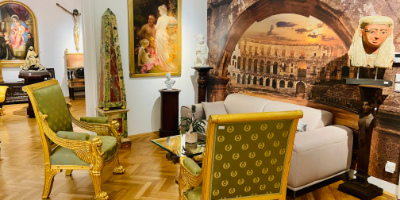
With several generations of experience in the national and international art trade and the expertise that comes with it, we can accurately assess and value any work of art. Our worldwide contacts to museums, large collections and a multitude of public institutions give you the certainty to always achieve the best possible sales price for your artwork at TIBERIUS-AUCTIONS.
Subscribe to our newsletter to be informed about upcoming auctions.
Login
Bid form
With this purchase order, I authorize TIBERIUS AUCTIONS to bid in my name and on my account up to the specified purchase limits or to contact me for a telephone bid during the auction.